Before you begin
This story-led series teaches practical concepts in attendance tracking, school management, and business software. Each chapter presents a relatable situation, followed by takeaways and links to explore the tools further.
Important note: Characters, dialogue, and the names of individuals or client businesses in these scenarios—apart from explicitly identified real brands—are fictional or dramatized for educational purposes. This is not a factual account of a real case or an allegation against any person or company. NetCity, Rigi24, Kadrebi and SkolaPlus are real brands and services; their features may evolve.
What will you learn?
- Attendance records need timely human follow-up.
- Parent accounts require verified identity and appropriate school permissions.
- Software shows recorded facts; understanding the reasons requires listening.
The Days Missing from the Calendar
Tuesday, 12:20 — Tbilisi
Nino Chkhikvadze was not a woman who cried easily. At forty-one, she had spent much of her life working, raising two children and keeping the household running. Her husband drove a truck and sometimes worked outside Tbilisi for days at a time. She got up at seven every morning, made breakfast, sent her children to school and went to work, believing she knew at least where they were going.
Until today. Today she learned that her fourteen-year-old son, Saba, had missed four days of school. Four days, not four hours or four lessons. Nobody had told her. She sat opposite Tamar Gabunia, the school principal, trying to remain calm.
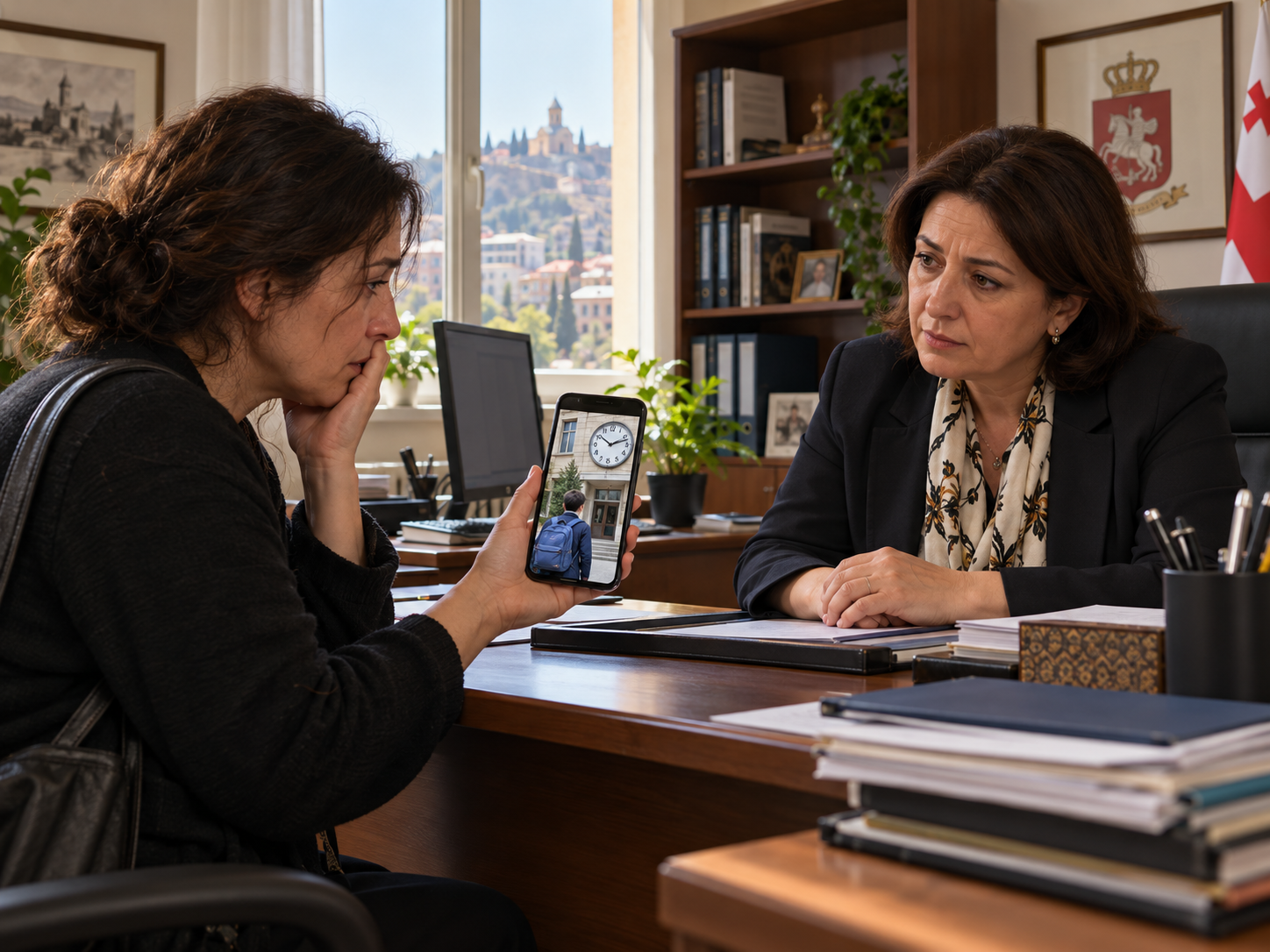
“Ms. Tamar, are you telling me he was absent for four days and nobody informed me?”
“The teachers recorded the absences,” Tamar said, resting her hands on the desk. “But the follow-up and notification weren't handled properly. We need to investigate where that responsibility failed.”
“Every morning I made his breakfast. He dressed, picked up his bag and left. Every afternoon he came home as usual!”
“I understand how worried you are.”
Nino took out her phone. “Look at this picture. He sent it yesterday and wrote, ‘Mom, I've arrived.’” Saba stood in front of the school with a blue backpack. The large clock by the entrance showed 10:14.
“Classes begin at nine,” Tamar said.
“He said the first lesson was cancelled.”
“It wasn't cancelled yesterday.”
Nino lowered the phone. “So he lied about that too?”
What the Mother Didn't Know
Tamar opened Saba's timetable on the school's system. Mathematics, Georgian, history, science, English: several lessons were marked absent.
“The teachers entered these?” asked Nino.
“Yes. Each teacher records attendance for their own class.”
“Then why couldn't I see it?”
Tamar paused. “Your parent account hadn't been activated yet.”
“If it had been, would I have known?”
“You could have viewed the recorded attendance, schedule and parts of his school progress. Automatic notifications also depend on the school's settings and follow-up procedures.”
Nino sank back in her chair. “I didn't even know we had this option.”
“That's part of the problem,” Tamar said. “Having a system isn't enough. We have to help families use it.”
“Can parents see homework too?”
“Homework entered by teachers, yes.”
Nino gave a bitter smile. “Every evening I'd ask whether he had homework. He said no, and I thought, what a wonderful school! When I was young we had two hours of homework every night!”
Tamar smiled too, but neither smile lasted. The question remained: where had Saba spent those four days?
12:45 — The NetCity Office
Nika was still thinking about the restaurant case that morning. He had seen a lot for his first day. Mari was answering Tamar's request for help activating parent access.
“Are we supposed to find out where the boy went?” Nika asked.
Mari laughed. “Nika, we're a software company, not private detectives!”
“Then what are we supposed to do?”
“The school needs instructions for enabling a parent's account. Investigating absences and looking after the student are the responsibilities of the school and family.”
“So we shouldn't just open that child's information ourselves?”
“Exactly. Student information is private. People should access only the information allowed by their role and responsibilities.”
Mari opened the SkolaPlus parent guide.

“Imagine a mother with two children at the same school. Once the parent-child relationship is correctly recorded and verified, she can see the authorized information for both from her own account.”
“But not information about other people's children.”
“Well done.”
“So parents won't need to ask about homework every night?”
“They can see whatever the teacher has entered.”
Nika considered that, then said solemnly, “If we had this system when I was at school, half my happy childhood memories would be gone!”
“Why?”
“Whenever I didn't do my homework, I'd say the teacher was absent. When I got a bad grade, I'd claim they hadn't checked the papers yet!”
“Then you're one of the reasons such systems exist!” Mari replied, laughing.
13:10 — The Principal's Office
Tamar asked Nino to stay a little longer and invited one of Saba's teachers in. Eka Tsereteli, the Georgian-language teacher, was in her thirties, wore narrow glasses and always tied her hair back.
“When did you last see Saba in class?” Tamar asked.
“Last Wednesday,” Eka said after thinking. “And something upsetting happened that day.”
“What happened?”
“At the school book fair, the money in the cash box didn't match the expected amount. Some pupils accused another child of taking money, without any evidence.”
“Why wasn't that reported to me?” Tamar demanded.
Eka explained that the fair organizer had initially suspected an accounting mistake and hadn't finished checking. Nino asked what this had to do with Saba.
“The child they accused was his best friend, Dato Abashidze. Saba stood up for him.”
“Dato? The quiet boy who's been to our house?”
“Yes.”
The Previous Wednesday — Georgian Class
The lesson was almost over. Students were collecting their things when someone shouted, “Miss! Dato took the book fair money!”
Dato jumped up. “I didn't!”
“Why were you beside the cash box yesterday?”
“I was organizing the books!”
Several students laughed. Dato's face went red. Saba stood from the back row.
“Stop it! If you've got proof, show it!”
“Why are you so upset?” another student shouted. “Are you his accomplice?”
More laughter. Eka quieted the class and told them not to repeat an accusation without evidence. Yet words can remain in a person's mind long after a lesson ends. Dato left early and Saba followed him. Starting the next day, neither boy appeared for the first class.
13:35 — A Message Marked Read
Nino put a hand to her forehead. “So he's missed four days because someone accused his friend?”
“We don't know yet,” Tamar cautioned. “We shouldn't jump to conclusions.”
Nino called Saba three times. No answer. She texted: “Saba, please answer. I'm at school.” The message was marked as read. A reply came: “Mom, I'm okay. Please don't be angry.”
“Where are you?” she typed. Silence. “Just tell me where you are.”
“Near the school.”
Nino sprang up, but Tamar suggested calling first and inviting the boys back to the safe environment of the school. This time Saba picked up.
“Mom…”
“Where are you?”
“Near the bookshop.”
“Are you safe?”
“Yes.”
“Is Dato with you?”
A pause. “Yes.”
“Come to school together. I'll wait right here.”
“Mom, please let me explain before you scold me.”
Nino closed her eyes. “I promise I'll listen first.”
14:00 — The Small Bookshop
The shop stood on a side street near the school. The window was full of workbooks, notebooks and colored pencils. An elderly man read a newspaper behind the counter. Saba and Dato stood beside the shelves.
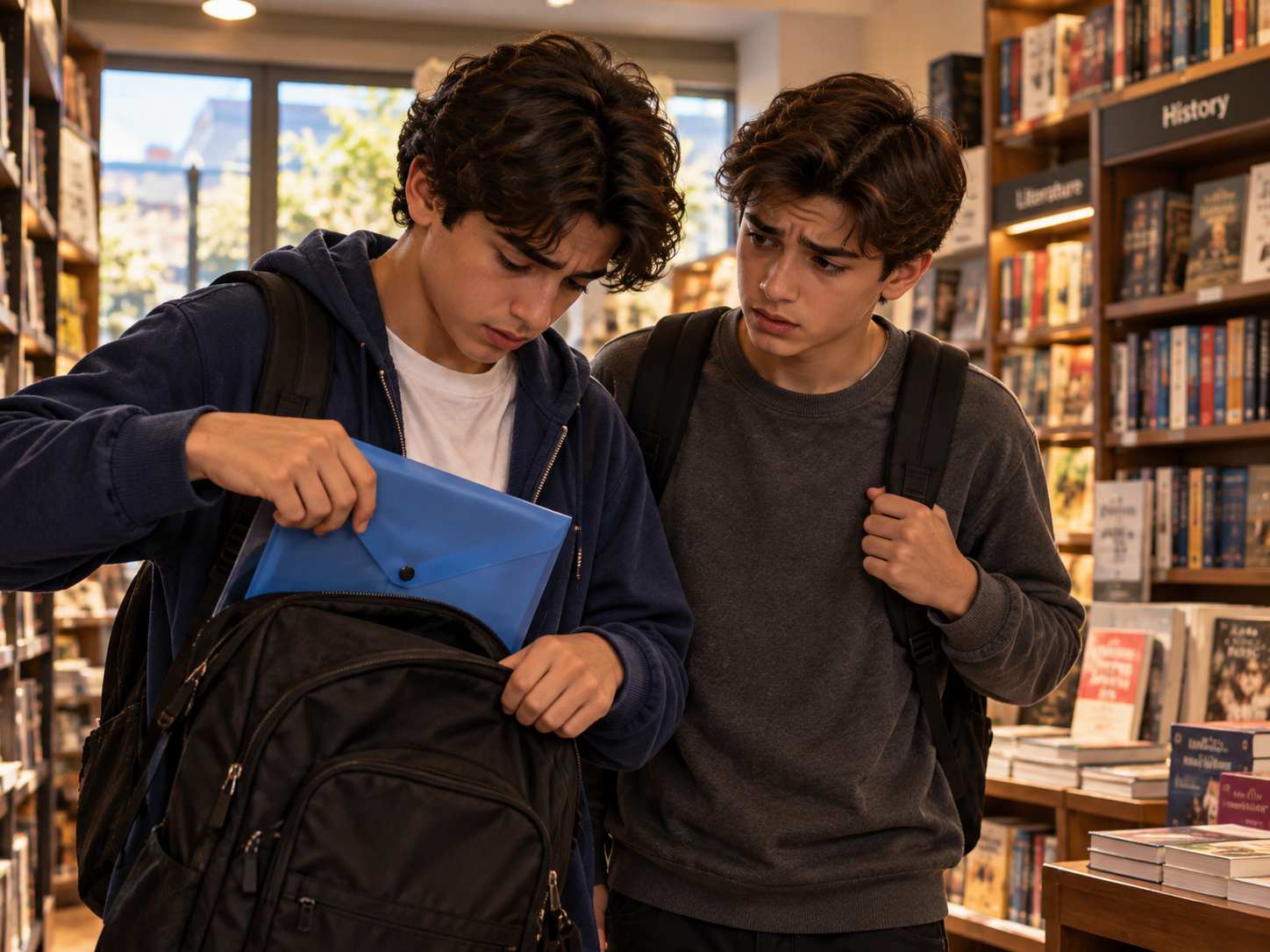
“Should we tell them everything?” Dato asked.
“Yes.”
“What if they don't believe us?”
“We'll show them the evidence we found.”
Dato looked down. “I don't want my mother knowing they think I'm a thief.”
“But she has a right to know what happened.”
Saba pulled a blue envelope from his bag. “We'll take this to school.”
“Are you sure?”
“No,” Saba admitted with a faint smile. “But we can't disappear for another four days!”
14:15 — Back at NetCity
Mari explained that a parent account is linked to a child's record only after the parent's identity is verified.
“So simply knowing a pupil's name isn't enough to see their information?” Nika asked.
“Of course not. The applicant must be a verified legal guardian, and the school must assign the correct permissions.”
“So this isn't just about displaying attendance; it's about trusting and protecting information.”
“Now you're learning,” Mari said.
Nika leaned back proudly. “I knew they'd recognize my talent on day one!”
Mari's phone rang. Tamar had called to say the parent account was now active, but the school also needed to review how absences were followed up. Mari suggested reviewing staff responsibilities and whatever notification settings were available. Tamar added that the two boys were expected back soon.
“So is the school mystery solved?” Nika asked after the call.
“Finding people is one thing,” Mari answered. “Understanding why they acted as they did is another.”
14:35 — The Truth Behind the Blue Envelope
The principal's door opened. Saba and Dato stepped inside. Nino rushed to embrace her son and held him silently for several seconds.
“Four days, Saba!”
“I know, Mom. I'm sorry.”
“Do you know what I imagined?”
Saba hung his head. Nino took a breath. “You said you would explain. I'm listening.”
Dato placed the envelope on Tamar's desk. Saba said, “We think these papers can help show Dato didn't take the money.” There were book-purchase receipts and a note inside. One receipt was for books ordered for the school fair.
“Where did you get these?” Tamar asked.
“From the bookshop that supplies the school. The owner helped us find copies.”
Dato explained, “When the cash was reported missing, I was helping the fair organizer arrange books.”
“Why didn't you tell us that day?”
“We thought you wouldn't believe us,” Saba said.
“And that's why you stayed away?”
“We thought we'd find proof quickly on the first day. Then we were scared to return and didn't know what to say.”
“You lied to me for four days to help your friend?” Nino asked softly.
Saba's eyes filled with tears. “I thought I was doing the right thing.”
“You could have asked me for help. I wouldn't have let you miss four days of school, but I would have helped you.”
“These receipts must still be checked against the fair's accounts,” Tamar said. “We cannot draw a final conclusion yet. But no one had the right to accuse Dato without evidence.”
Dato finally raised his head. “Investigating the cash box is the adults' job,” Tamar added. “Not yours.”
15:10 — Two Different Problems
“We have two separate problems,” Tamar told Nino. “First, nobody followed up on the boys' absences promptly. Second, the boys felt that no one would listen to them.”
“Where exactly does the software help?” Nino asked.
Tamar showed her the school report. “Attendance tells us which days they weren't in class. Homework and educational reports may also reveal changes in how a student is doing. When families have proper access and a school follows its notification procedures, they can find out earlier.”
“But software can't tell you why the boys did this.”
“Exactly. No platform can replace relationships between teachers, students and parents. It helps prevent important signs from being overlooked.”
“I wish I'd seen this four days ago,” Nino said.
“And we should have called you sooner,” Tamar admitted. “That was our responsibility.”
17:50 — The End of the First Day
Back at NetCity, Nika packed his bag while Mari reviewed the day's requests. Giorgi had just returned from a client meeting.
“How was your first day?” he asked.
“Wonderful! Someone at a restaurant nearly lost his job this morning, and this afternoon two children turned out to have missed four days of school!”
Giorgi stared. “Are you sure you joined a software company?”
“I'm beginning to wonder myself!”
Mari laughed. Giorgi asked whether Nika had learned anything about the software.
“An entry scan isn't the same as a final attendance report; shifts matter. Parents need proper access to school data. And management passwords shouldn't be shared with everyone.”
“Not bad for day one,” Giorgi said.
Nika glanced toward the far desk. The salt-and-pepper-haired man was still at his laptop, quietly doing his work. “Is our colleague in that corner always so silent?” Nika whispered to Mari.
“Most of the time.”
“I've only seen him coding or tinkering with devices. Did he even have lunch?”
Mari almost said something but stopped herself. “You'll get to know him in time.”
“I hope he'll come out from behind that monitor someday and learn my name!”
Mari looked down at her report to hide her laughter.
18:05 — The Last One to Leave
The others gradually left. On his way out, Nika passed the desk with the open code editor, little circuit board and electronic components. The man looked up.
“Nika, how was your first day?”
Nika was surprised that his quiet colleague knew his name. “Very good, thanks… Morteza, right?”
“Yes.”
“Still working?”
“A little longer.”
“I'm leaving already. It feels as if I've worked a whole week!”
Morteza smiled. “That's normal at first. Well done today.”
“See you tomorrow.”
Nika left still assuming Morteza was simply another technical colleague who spent too much time programming. Nothing more.
19:42 — A Message from the Past
The office was quiet. Morteza remained at his computer, listening to the fan and the tapping keyboard. His phone vibrated. An unknown Georgian number wrote: “Hello. You probably don't remember me. Years ago you installed an elevator-control device in our building. There's something I'd like to discuss.”
“Hello. Go ahead,” Morteza replied.
“That device is still working.”
He smiled. Then the next message erased the smile: “There's something I think you ought to know.” The typing dots appeared, disappeared, then appeared again.
“Can we meet tomorrow? It concerns one of your earliest projects in Tbilisi.”
Morteza glanced at the clock: 19:46. He hadn't thought about that building for years. It was one of the first places he installed his controller, at a time when even finding someone willing to hear about his product was difficult. He reread the message and left the unknown number open on his screen instead of returning to his code.
End of Chapter Two
What We Learned
1. Student attendance records are useful only when schools enter and review them promptly.
2. Parent accounts can show attendance, timetables, teacher-entered homework and permitted communications.
3. Roles and access levels must be based on verified guardian identities and school authorization.
4. Notifications and reports do not replace human follow-up.
5. Systems can illuminate facts, but understanding people's motives takes conversation and investigation.
Official resources:
https://skolaplus.ge/
https://skolaplus.ge/school-attendance
Publication note: This is a fictional narrative. Secondary characters and events are invented. Illustrations are not screenshots of the software. Operational claims must be checked against the current deployed version before publication.
Tools and further reading
Explore the real services and related guidance behind this chapter:
Learning note: examples are illustrative, not a substitute for reviewing real records.