What is CRM and why do even small businesses in Georgia need it?
CRM is not only for large companies. Learn how customer history, bookings, notes, follow-ups, reminders and behavior data can help a small service business grow.
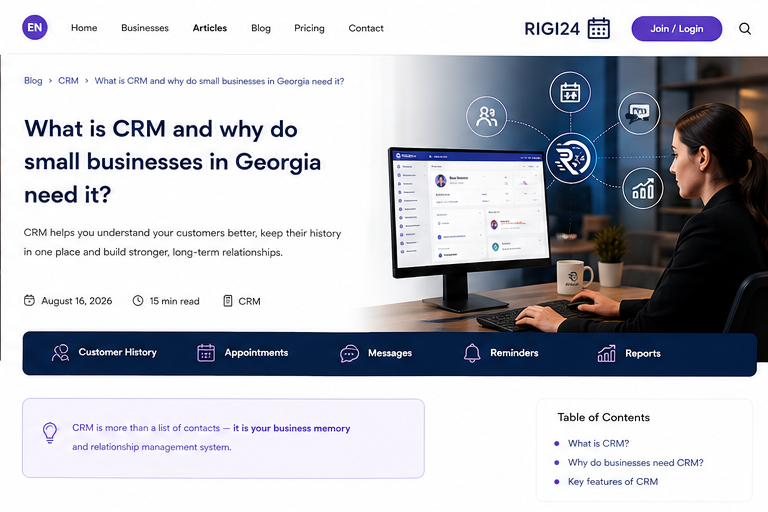
When many small-business owners hear the word CRM, they imagine an expensive and complicated system built only for large companies. In reality, CRM can be even more valuable for a small service business.
If a beauty salon has 100 customers, a dentist has several hundred patients, a consultant sees clients every day, or a repair shop has repeat visitors, those customer relationships quickly become one of the business's most valuable assets.
CRM helps keep that information out of notebooks, staff phones, WhatsApp chats and people's memory. In simple terms: CRM means understanding, keeping and managing your customer relationships better.
What is CRM?
CRM stands for Customer Relationship Management. It is much more than a contact list. A good CRM can show who a customer is, how often they return, which services they use, which provider they prefer, what appointments they had, whether they cancelled or no-showed, and what notes or follow-ups are attached to their profile.
How is CRM different from a customer notebook?
A notebook may tell you “Anna — 555123456”. CRM can also tell you when Anna last visited, how many appointments she completed, what she usually books, which provider she prefers, whether she ever missed an appointment and whether she has a future booking.
Why is customer information a business asset?
Many businesses operate for years without a real customer database. Some numbers are on a staff member's phone, some details live in WhatsApp or Instagram, and some are on paper. CRM keeps customer information with the business, not with one person's memory or device.
Do small businesses really need CRM?
Yes. “We know our customers” works only while the customer base is very small. As the business grows, remembering every service, preference, last visit, cancellation and follow-up becomes impossible. CRM becomes the digital memory of the business.
A simple beauty salon example
A customer calls. Reception searches the phone number and immediately sees that the customer has visited 11 times, usually books hair color, prefers one provider, has not visited for four months and has never no-showed. Instead of asking “Have you been here before?”, reception can say: “Last time you booked hair color with Nino. Would you like the same provider?”
CRM for clinics, consultants and automotive services
CRM does not replace a medical record system, but it can manage appointment history, providers, future bookings and follow-ups. For consultants and lawyers, it helps track previous and upcoming sessions. For automotive businesses, it keeps useful service history for repeat customers.
Existing customers are extremely valuable
Businesses often spend most of their energy attracting new customers, but people who have already chosen you, trusted you and experienced your service should not be forgotten. CRM makes it easier to identify inactive customers and reconnect at the right time.
CRM and booking should work together
In an integrated system, every booking should be connected to a customer: customer books → appointment happens → customer history updates. For more on this idea, read why Rigi24 is useful even when customers do not book online.
Every booking creates useful customer data
Appointment history can reveal visit frequency, preferred services, preferred providers, cancellations, no-shows and the average interval between visits.
CRM and reducing no-shows
Customer history can reveal whether someone reliably attends or repeatedly misses appointments. That information can support smarter reminders, manual confirmation or different booking rules. See our guide on reducing customer no-shows.
Why customer notes matter
Some useful information does not fit into a standard field. Notes may record a preferred provider, a good time to call or a follow-up requirement.
CRM is not only about sales
For a service business, CRM is mostly about maintaining the customer relationship before, during and after the appointment.
CRM makes the experience more personal
Knowing customer history makes interactions feel more professional. Questions like “Would you like the same provider as last time?” show that the business remembers the customer.
CRM, reminders and reviews
A booking is created, a reminder is sent, changes trigger notifications and after the appointment the business may send a thank-you message or request a review. When all of this is connected to one customer profile, communication becomes more consistent.
CRM and customer reputation
Successful bookings, cancellations and no-shows can help businesses manage booking risk more intelligently. This should always be implemented fairly and with safeguards against misuse.
How CRM helps staff
If one staff member answers today and another answers tomorrow, customer knowledge should not disappear between them. Authorized staff can view relevant history. If an employee leaves, the business still keeps the customer record.
CRM and reporting
Structured data enables reports on new customers, returning customers, inactive customers, no-shows, cancellations, popular services and high-demand providers.
New customers vs. loyal customers
A customer who visited once and a customer who returned 30 times do not have the same relationship with the business. CRM helps identify loyal customers so the business can offer appropriate priority or personalized service.
Can CRM become annoying?
Yes, if used badly. CRM should not mean “send more messages.” The goal is better and more relevant communication.
Customer information must be secure
Staff access should be controlled and limited to what each role needs. Audit logs and permissions can improve transparency and protect customer information.
How does Rigi24 connect CRM and bookings?
Rigi24 is designed so CRM is not a disconnected database. Bookings, statuses, services, providers, notes, follow-ups, cancellations and no-shows can all contribute to the customer history. If you are new to digital booking, start with what online booking is and why service businesses in Georgia need it.
Phone customers also belong in CRM
Customers do not need to book online. Phone, walk-in and staff-created bookings can all be recorded and connected to the same customer profile.
A complete real-world example
Imagine a small dental clinic in Tbilisi. A new customer calls, their phone number is saved, an appointment is created, a reminder is sent, the visit is completed and a follow-up for two months later is recorded. When the customer calls again, the entire relationship history is available.
CRM for business growth
When you understand customers better, you can see which services bring people back, which times are quieter, which providers have stronger demand and how many first-time customers actually return.
CRM + Rigi24 public business profile
Rigi24 covers both sides of the business. Internally: customers, CRM and appointments. Externally: public profile, search, articles, reviews and online booking. That creates a path from customer acquisition to customer retention inside one ecosystem.
Acquisition without retention is not enough
Sustainable growth happens when a new customer arrives, has a good experience, their history is kept and they return.
Does CRM need to be complex from day one?
No. For a small business, name, phone, bookings, services, notes, customer status, last visit and reminders may be enough. More advanced features can be added later.
A good CRM should make work easier, not harder
If staff must fill in dozens of fields for every customer, they will stop using the system. Good CRM should capture useful information naturally as part of normal booking and service workflows.
Why service businesses in Georgia need CRM
In Tbilisi, Batumi, Kutaisi, Rustavi and other cities, many service businesses work with both local and international customers. Multilingual access, structured customer history, booking management and digital communication can be a real competitive advantage.
Summary
CRM is not only for large companies. Any business with repeat customers already needs some form of relationship management. The only question is whether that history lives in memory, notebooks, Excel and WhatsApp — or in a structured system.
Rigi24 — Book. Manage. Grow.
Frequently asked questions
Is CRM only for large companies?
No. Small businesses can benefit greatly from CRM.
Is CRM just a contact list?
No. CRM combines contact information with bookings, services, cancellations, no-shows, notes and other interactions.
Can phone customers be added to CRM?
Yes. Staff can create the customer and booking directly.
Can CRM help reduce no-shows?
Yes. Customer history plus reminders and booking controls can help manage no-show risk.
How does CRM help retention?
It helps identify last visits, customer history, inactive customers and follow-up needs.
Is Rigi24 only a CRM?
No. CRM is one part of Rigi24 alongside bookings, calendars, services, providers, notifications and public business profiles.
Related Rigi24 Academy articles
- Even if your customers do not book online, why do you still need appointment management and CRM?
- How to build a Rigi24 business profile that attracts more customers
- What is HR management and how does Kadrebi complement Rigi24 for better business management?