What is HR management and how does Kadrebi complement Rigi24 for better business management?
A complete guide to HR management and Kadrebi features for attendance, shifts, leave, payroll, RFID, GPS, reports, and how it complements Rigi24 customer and booking management.
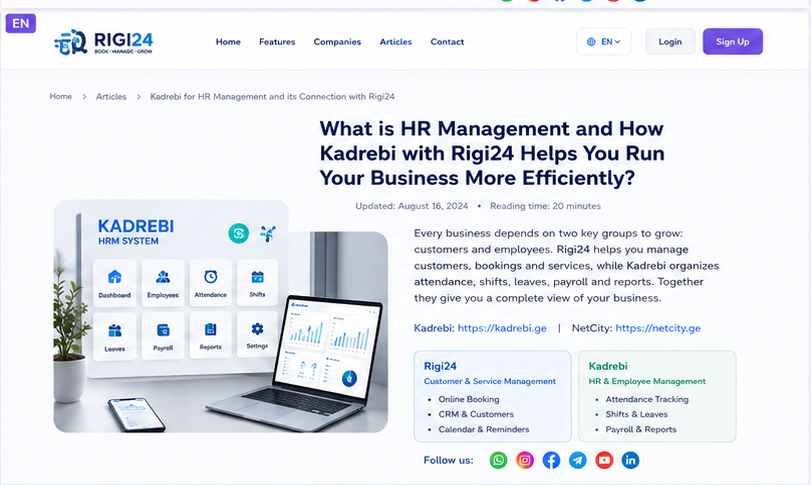
What is human resources management, and how can Kadrebi work alongside Rigi24 to help manage a business more completely?
Every business depends on two main groups in order to grow:
Customers and employees.
You may have the best booking system, attract many customers, and deliver high-quality services; but if employee management, attendance, shifts, leave, overtime, and workforce performance are not organized, an important part of the business is still being managed manually.
On the other hand, having a strong human resources system without proper customer and booking management does not provide a complete picture of business operations either.
That is why NetCity has developed two different solutions for two important areas of business management:
Rigi24 for managing customers, services, and bookings.
And Kadrebi for managing employees and human resources.
These two systems are not intended to replace each other. Each solves a different problem, and together they can digitize a large part of a business's daily management.
Human resources management is not just recording clock-in and clock-out times
When people hear “human resources system,” many managers first think about an attendance device.
For example:
What time did the employee arrive?
What time did they leave?
How many minutes late were they?
But human resources management is much broader than that.
A proper HR system should be able to answer questions such as:
- Who is at work today?
- Who was late?
- Who left the workplace early?
- Who worked overtime?
- Which employees are on leave?
- What shift is assigned to each employee?
- What is the status of a leave request?
- Which employees are managed by each department manager?
- How much attendance did an employee have this month?
- How are salary and working hours calculated?
- How many employees are assigned to each branch?
- Who recorded attendance by mobile and who used an attendance device?
As the number of employees grows, answering these questions manually becomes increasingly difficult.
Why does human resources management affect business profitability?
Employee payroll is usually one of the most significant expenses for many businesses.
Even small differences in:
- Lateness
- Early departure
- Overtime
- Absence
- Leave
- Actual working hours
can become a significant amount when multiplied by the number of employees and the months of the year.
But the issue is not only cost.
Better human resources management can have a direct effect on:
Organizational discipline, service quality, customer satisfaction, employee productivity, and management decision-making.
What is Kadrebi?
Kadrebi is a human resources and attendance management system developed by NetCity for managing employees and HR-related processes.
More information:
https://kadrebi.ge
Kadrebi is designed to bring scattered information about employees, attendance, shifts, requests, reports, and HR-related calculations into one centralized system.
Complete employee profiles
Each employee can have a dedicated profile in the system.
This profile can be used to manage information related to the employee and their work activity, while authorized managers can access relevant employment history.
Instead of employee information being scattered across Excel files, paper documents, messaging apps, and different systems, there is one central point for managing it.
Attendance management
One of Kadrebi's core functions is managing employee entry and exit.
The system can record employee attendance times and make them available to managers through reports.
Depending on the organization's infrastructure, attendance can be recorded in several different ways.
Attendance devices and RFID
For businesses that require physical attendance recording, Kadrebi can be used with attendance devices and RFID technology.
An employee records attendance using a card, chip, or another configured method, and the information is transferred to the system.
As a result, the manager no longer has to manually review arrival and departure times from paper logs or separate files.
Mobile attendance
Not every business needs a wall-mounted attendance device.
For some companies, mobile attendance is more useful for employees who work outside the office, sales teams, technicians, or employees working across different branches.
Kadrebi also supports mobile-based attendance approaches.
GPS and IP control
In scenarios where a business wants to control the approved location or network from which attendance can be recorded, mechanisms such as:
- GPS
- IP
can be used.
For example, a policy can be defined so mobile attendance is only accepted from a specific location or an authorized network.
Multi-shift management
Not all employees work the same hours.
An organization may have:
- Morning shifts
- Evening shifts
- Night shifts
- Rotating shifts
- Different working hours for different departments
Kadrebi is designed to manage multiple work shifts, allowing the system to evaluate each employee's attendance according to that person's actual schedule.
Employee lateness
If an employee is expected to arrive at 09:00 but records attendance at 09:17, the system should be able to identify that difference.
When this information is recorded in a structured way, managers can see real reports about employee lateness instead of relying on estimates.
Early departure
Arrival time is not the only thing that matters.
If an employee leaves the workplace before the end of the scheduled workday, that can also be reflected in reports.
This makes it possible to review actual working hours much more accurately.
Overtime
In many companies, overtime is one of the areas where manual calculation can easily lead to errors.
Kadrebi can compare actual working-hour information with the defined schedule and provide the data required to manage overtime.
Break and rest-time management
In some businesses, recording only the first entry and final exit of the day is not enough.
The duration of breaks or temporary exits may also matter.
Break management provides a more accurate picture of actual employee presence and activity.
Leave management
Employee leave is another process that many companies still manage through phone calls, messages, or paper forms.
Kadrebi provides the ability to submit and manage leave requests.
As a result, both the employee and the manager can clearly follow the status of a request.
Requests and approvals
An employee can submit a request in the system, and the relevant manager can review it.
This is not limited to leave. It can also provide the foundation for different request-and-approval workflows within an organization.
As a result, it becomes clear:
Who submitted the request?
When was it submitted?
What was the request about?
Who reviewed it?
And what was the final result?
Department management
In larger companies, one manager cannot directly manage every employee.
Kadrebi supports a departmental structure.
For example:
Sales
Technical
Finance
Support
Administration
Each department can also have its own responsible manager.
Department manager portal
Each department manager can manage the employees under their responsibility according to the access level assigned to them.
This means all HR operations do not have to be handled only by the company's main manager.
Employee self-service portal
One important feature of a modern HR system is that the employee should not only be the subject of the system; they should also have access to relevant information.
Employees can use their personal portal to view information and perform permitted actions.
This also reduces the workload on the HR department.
Overtime, lateness, and early departure in one report
Imagine a company with 50 employees.
Manually calculating all:
- Late arrivals
- Early departures
- Overtime
- Absences
at the end of each month is not simple.
When the information is recorded in the system from the beginning, reporting becomes much faster and more accurate.
Management reports
Data becomes valuable when it can be turned into reports.
Kadrebi can generate different reports from employee and attendance information.
Instead of reviewing hundreds of individual records, a manager can obtain the result they need through a report.
Excel and PDF export
Excel remains an important part of the workflow for many companies.
That is why exporting reports in formats such as:
Excel and PDF
can be very useful for accounting, management, or archiving.
Payroll
One important use of attendance information is in the salary calculation process.
When:
Working hours
Leave
Lateness
Overtime
Absence
are clearly recorded in one system, there is a more accurate basis for payroll calculations.
Kadrebi also includes capabilities related to Payroll and salary calculations within its system structure.
Tax and pension
Payroll is not only about the gross salary amount.
Tax calculations and, where applicable, pension contributions are also part of the employee financial process.
Keeping this information in an integrated system can reduce errors caused by manual work.
KPI and organizational discipline
Human resources management is not only about the number of hours an employee is present.
In more advanced systems, managers may also need to see performance and disciplinary information alongside other employee data.
Kadrebi also provides a structure for developing and managing this type of information.
Notifications
Imagine that an employee arrives late.
Or their request is approved.
Or another event requires notification.
The system can use notifications to make communication between employees and managers faster.
Depending on the configuration, these notifications can be delivered through channels such as the system itself or SMS.
Multi-branch management
Many businesses operate from more than one office.
For example, a company may have branches in:
Tbilisi
Batumi
Kutaisi
or at several locations within the same city.
Kadrebi supports a Multi-Branch structure so information from all branches can be managed in one system while remaining separable and reportable by branch.
The difference between “attendance recording” and “human resources management”
Buying an attendance device does not mean you have an HR system.
A device may only tell you:
This person checked in at 08:58.
But a human resources system should be able to determine:
What time were they supposed to arrive?
Which shift were they assigned to?
Were they late?
Were they on leave today?
How long did they work?
Did they work overtime?
What effect does this information have on the monthly report?
Kadrebi is designed for exactly this management layer.
How does better employee management affect customers?
At first glance, human resources and customers may seem like separate topics.
But in reality, they are closely connected.
Imagine a beauty salon with many bookings, but one specialist fails to come to work without notice.
What happens?
The customer becomes dissatisfied.
Or imagine a clinic with many bookings for one day, but the staffing schedule is not aligned with booking capacity.
Again, the effect reaches the customer.
Therefore, employee management ultimately affects the quality of the customer experience as well.
This is where Kadrebi and Rigi24 meet
Rigi24 and Kadrebi are two different products.
Rigi24 focuses on the customer-facing side of the business:
- Customers
- CRM
- Services
- Bookings
- Calendar
- Service providers
- Reminders
- Customer communication
- Public business profile
- Articles
- Reviews
- Customer acquisition
In contrast, Kadrebi focuses on the internal organization:
- Employees
- Attendance
- Shifts
- Leave
- Breaks
- Lateness
- Early departure
- Overtime
- Departments
- Managers
- Payroll
- Reports
- Attendance devices
- RFID
- GPS/IP
- Branch management
A provider in Rigi24 is not the same as an employee in Kadrebi
This difference is important.
In Rigi24, when a provider is defined, the main purpose is to determine:
Who can provide a particular service to a customer, and at what time?
This is an Appointment Resource concept.
Kadrebi, however, is responsible for managing that person's relationship with the organization:
When did they arrive?
What shift were they assigned to?
Did they take leave?
How much overtime did they work?
How is their salary calculated?
In other words, Rigi24 is not intended to become an HR system, and Kadrebi is not intended to replace a customer booking system.
Example: a beauty salon
Imagine a salon with 10 specialists.
In Rigi24, the manager defines:
Nino provides hair-color services.
Mariam provides nail services.
Which times each of them is available for customer bookings.
The customer books an appointment, and it appears in the calendar.
But in Kadrebi, the manager checks:
What time did Nino arrive today?
Was she present according to her shift?
How many hours did she work this month?
How much overtime did she have?
When is her leave?
Therefore, the same person is managed from two different perspectives in the two systems.
Example: a clinic
In Rigi24:
The patient selects a doctor.
Sees available time slots.
Books an appointment.
Receives a Reminder.
The booking history is added to the customer's CRM profile.
In Kadrebi:
Management can control staff attendance, shifts, leave, overtime, and HR information for the organization.
In other words, one system manages the outside of the organization and the customer, while the other manages the inside of the organization and employees.
Does every business using Rigi24 also need Kadrebi?
Not necessarily.
If one person works independently, they may not yet need a complete HR system.
But when the business starts employing several people, especially if it:
- Uses shifts
- Has multiple branches
- Needs attendance tracking
- Manages leave and overtime
- Calculates employee payroll
using a serious human resources system becomes much more valuable.
Why do we not copy Kadrebi into Rigi24?
Because each of these areas is already large enough on its own.
Adding complete:
Payroll
Attendance
Tax
Leave
Shift
HR Reports
RFID Devices
functionality to Rigi24 would turn the booking system into an unnecessarily heavy and complex piece of software.
A better model is for each product to do its core job exceptionally well, while communicating with the other product where needed.
The future: connecting Rigi24 and Kadrebi
This creates a very interesting opportunity.
Imagine a business that uses both systems.
In the future, operational information from Rigi24 and human resources data from Kadrebi can be connected.
For example:
If a specialist records leave in Kadrebi, the booking system could know that the person is unavailable.
Or a manager could compare customer demand in Rigi24 with workforce planning.
For example, they could discover:
Bookings are high on Saturdays, but the number of employees is lower than needed.
At that point, this is no longer just a booking system or an attendance system.
It becomes a way to use data for smarter business management.
You manage customers; do not forget employees
Many businesses invest in marketing and customer acquisition.
That is essential.
But a new customer only creates value if the business can deliver good service.
And service quality depends heavily on:
- Employees
- Discipline
- Planning
- Attendance
- Workforce capacity
That is why customer management and human resources management are two sides of the same issue.
Rigi24 + Kadrebi
These two products can be described very simply:
Rigi24
Manage customers and services.
Kadrebi
Manage employees and human resources.
When both sides are managed correctly, the manager has a much more complete picture of the business.
What types of businesses can use Kadrebi?
Almost any organization with several employees can eventually need a human resources system.
For example:
- Beauty salons
- Clinics
- Medical centers
- Service companies
- Retail stores
- Restaurants
- Factories
- Offices
- Schools
- Training centers
- Technical companies
- Multi-branch organizations
- Public and private organizations
The way Kadrebi is used and the required features can differ from one organization to another.
Where can you learn more about Kadrebi?
For more information about the Kadrebi human resources and attendance management system, visit the official website:
https://kadrebi.ge
Kadrebi is one of NetCity's software solutions for digitizing employee management and human resources processes.
And if your main challenge is customers and bookings?
If your main needs are:
- Booking management
- Customer CRM
- Services
- Bookable providers
- Calendar
- Reminders
- Public business profile
- Customer acquisition
- Online booking
then Rigi24 is designed for that part of the business.
There is no need to force one system to do everything.
For customers and bookings: Rigi24
For employees and human resources: Kadrebi
Summary
Digitizing a business does not simply mean having a website or online booking.
Behind every successful service is a team.
If customers are managed through a system while employees are still managed through paper, Excel, and scattered messages, only half of the digital transformation has been completed.
Kadrebi is designed to bring structure to the human resources side of a business.
Rigi24 is designed to organize and develop the customer and service side.
Together, these two products can follow a simple philosophy:
Manage customers better, manage employees better, and give managers better information for making decisions.
Rigi24 — Book. Manage. Grow.
Kadrebi — Smarter human resources management
Related Rigi24 Academy articles
- What is CRM and why do even small businesses in Georgia need it?
- How to build a Rigi24 business profile that attracts more customers
- Bookings from Instagram, WhatsApp, Phone or Website? How to manage every customer request in one system