Before you begin
This story-led series teaches practical concepts in attendance tracking, school management, and business software. Each chapter presents a relatable situation, followed by takeaways and links to explore the tools further.
Important note: Characters, dialogue, and the names of individuals or client businesses in these scenarios—apart from explicitly identified real brands—are fictional or dramatized for educational purposes. This is not a factual account of a real case or an allegation against any person or company. NetCity, Rigi24, Kadrebi and SkolaPlus are real brands and services; their features may evolve.
What will you learn?
- Leadership means responsibility and teamwork, not necessarily sitting in the executive chair.
- An offline elevator controller operates independently without a constant internet connection.
- Access controls must protect customer and school records.
- A quotation is not proof of payment; investigate before accusing anyone.
- NetCity developed hardware alongside Kadrebi, SkolaPlus, and Rigi24.
The Empty Desk
Rigi 24 Book
Chapter Seven: The Empty Desk
A Narrative About a Chair, Some Misunderstandings, and Something Done Quietly
8:03 — While the Office Was Still Asleep
At 8:03 on Monday morning, the sun had just risen over the rooftops of Tbilisi. Shop windows were lighting up one by one, buses were pulling into their stops, and the city was slowly waking up.
In a store, the first shift employee held his RFID card close to the attendance device. A short sound was heard, and his entry was recorded. The store manager had not yet arrived at the workplace, but the information was displayed on the Kadrebi panel. At the second branch of the same chain, the shift supervisor was reviewing the shifts to ensure that the schedule for the week was aligned with the employees' arrival times.
A few streets away, a teacher opened the class list at a school. The absence of one of the students was recorded, and the information was placed in SkolaPlus according to each person's access level. In a restaurant, a customer viewed the online menu by scanning the table code. In an old building, a resident placed his access card inside the elevator cabin in front of the card reader, and the desired floor was activated. That controller was of the offline type; it did not require internet access or real-time confirmation from a server.
A little further away, a guest contacted the apartment owner through the GSM intercom. The conversation was established, and after the apartment owner's approval, the door opened.
None of these events had started with a phone call to the manufacturer. It was also not intended for every routine task to require a call to support.
In the NetCity office, Morteza was sitting at the technical desk. A cup of tea was next to the keyboard, two monitors were on, a notebook full of notes was beside him, and an electronic board was at hand. He had started working around eight; before the official company hour, which was ten in the morning.
On one of the screens, a part of the software code was open. He reran a test he had left unfinished the night before. This time, the error did not recur. However, instead of immediately concluding that the problem was solved, he tested a second and third case as well. Then he marked that task with a small sign and moved on to the next one.
A few steps away, there was the large management desk: a glossy wooden surface, a black leather chair, and a flower pot that Mari had moved the week before. The chair was empty.
If someone looked into the office from behind the glass, they might think the manager had not yet arrived and the workday had not begun.
But at that very moment, part of the company's work had progressed.
Nine fifty-seven; the case of the invisible man.
Nika arrived at nine fifty-seven. He placed his bag on the chair and, with the expression of someone who has broken an important record, said: "I came three minutes early. I hope this success gets recorded in my personnel file."
Mari looked away from the monitor. "We will record it. Along with the times you asked where the tea is since yesterday."
"Those questions are for evaluating welfare services."
"Evaluation result?"
"The tea is good. The management chair is good too. It's just that the company manager is a bit invisible."
Mari stared at him for a moment. "What?"
Nika pointed to the end of the room. "I come every day, that desk is empty. When does the manager usually come?"
"Earlier than you."
"Then how come I haven't seen him so far?"
"Maybe because when you come, you go straight for the kettle."
"I'm asking seriously."
Mari hid her smile. "I'm answering seriously too."
Nika leaned in and said softly, "I want to talk to him one day. After all, the person who hired me should know what a valuable force has entered the company."
"He knows the outcome of your hiring, don't worry."
"Does that mean he has seen me?"
"Nika, did you forget your interview?"
"The same video call you arranged? With my previous internet, my image would freeze every thirty seconds!"
"Exactly. I interviewed you, wrote down the results, and sent them for review. The manager confirmed afterward that we should start the collaboration."
Nika thought for a moment. "So the manager has made a decision about me, but I still don't know who it is?"
"It seems that's the case."
"Strange. So he might be in this very building right now, and I wouldn't even recognize him?"
Mari glanced briefly at the technical desk. Morteza had set aside his headphones and was focusing on a software error.
"Maybe."
"I'll start investigating from today."
"I just hope you haven't spoken ill of anyone before your investigation is over."
Nika confidently said, "Me? Not at all!"
Mari raised an eyebrow.
"Well, don't count that thing I said yesterday about companies without managers."
"Did you say anything else?"
"Not for now. But if this case drags on, I can't guarantee anything."
Mari laughed. "Good luck, detective."
Ten twenty; a company that wasn't like in the movies.
At ten twenty, Nika was standing next to Mari. On the support page, several new requests, two recorded responses, and a few items awaiting follow-up were visible. Mari opened one of the requests and set aside the information that Nika didn't need to see.
Nika asked, "It's strange. You have several different products here, but the phone isn't ringing constantly. Is everything really that quiet?"
Mari said, "Do you want the phones to ring twenty-four hours a day?"
"No, but in movies, tech companies are always busy. Someone is running, someone is shouting that the server is down, someone is sitting in the middle of the room with three laptops."
"Our customers didn't buy tickets for the disaster movie."
Nika laughed. "So this silence is good?"
"Sometimes yes. Look, this store has adjusted its branch's working hours by itself. This service center has changed its appointment capacity. The supervisor of a company has updated his employee's shift. The school has recorded the attendance of classes. All of this has been done without contacting us."
"So a good product is one that makes customers call less?"
"A good product should simplify the usual tasks for the customer. If any small change requires a phone call, the problem lies in our design or training. Of course, when an issue arises, the responsibility for support remains intact."
Nika said: "I thought software meant a page full of buttons."
"That's just the appearance. The customer wants results. Some need to manage employee attendance, some need to manage appointment times, and some need to manage orders. Our job is to understand the issue correctly before choosing the tools."
At that moment, Giorgi entered with two folders. His call about a collection in Gori had just ended.
"Hello. For today's customer, we need to prepare two proposals; one for the branch that has a stable internet connection and one for the second location where the connection is unreliable."
Nika asked, "So their attendance device isn't the same?"
Giorgi said, "It's still unclear what device they need. First, we need to understand how many employees they have, what their shifts are like, and where they want to see the information."
"So first the issue, then the price?"
"Finally, you said something right."
Nika placed his hand on his heart. "I'll print this encouragement and put it on the desk."
Giorgi continued, "For attendance, Kadrebi can work with the online device, or in some cases with location-based attendance registration and the application. For places where there is no stable internet, we need to separately examine the offline solution. We never suggest a device solely for the sake of selling a device."
Mari said, "And the information of each branch should also be viewed according to the managers' permissions."
Nika looked between the two. "Did you two memorize each other's answers beforehand?"
Giorgi said, "No. This is called teamwork."
Then he added mischievously, "If you want to prepare a report about the manager's role, give it directly to him at the end of the day."
Nika sighed. "First, I need to find him."
Giorgi looked at Mari. Mari busied herself typing so her smile wouldn't be seen.
Technical desk; the meeting place for all questions.
Half an hour later, Giorgi placed Gori's customer folder next to Morteza's desk.
"The second branch doesn't have a stable internet connection. I don't want to make an online proposal without checking. What situations do you think are more suitable?"
Morteza stepped away from the monitor. "First, clarify how each branch should register check-ins and check-outs, who is responsible for shift approvals, and who the reports go to. It might be enough to register with the app and location; they might also need an offline device. Don't make any promises before understanding the limitations."
"I'm asking these same questions."
A few minutes later, Mari took the same route.
"One of the branch managers has requested access to the report of another branch. He says he knows the page address, but he can't get access."
Morteza said, "It's good that he can't get access. The page address shouldn't replace the authorization. The request should be referred to the group manager. Until the user's role is clarified, don't even open the summary report."
"Okay. I will follow up on the managerial approval."
The door opened and a young man with curly hair entered, holding a folder. Giorgi got up.
"Luka! Is your leave finally over?"
Luka smiled. "Yeah, but from your voice, I can tell my leave was more beneficial for myself."
Mari introduced him to Nika. "This is Luka. He handles administrative coordination, files, and customer follow-ups alongside Giorgi. When Nika started, Luka was on leave."
Nika reached out his hand. "So the second empty chair has found its owner too!"
Luka laughed and said, "Are you responsible for finding the owners of chairs?"
"Temporarily. I'm following up on an important case."
Luka took a few papers to his desk, then came back to Morteza.
"The manager of an old building called about the cost of repairing the controller and extending support. His device has just arrived. Can I give him the final cost?"
"Not yet. First, I need to test the device. Tell him the receipt has been registered, and after the technical review, we will announce the result."
Luka nodded. "Then I will put the case in pending review status."
Nika was watching everyone from across the room. Giorgi had consulted someone about the sales proposal, Mari about user access, and Luka about customer responses.
That same person was sitting at the technical desk, not at the large management desk.
Nika quietly asked Mari, "What exactly is Morteza's position?"
"What do you guess?"
"He's a programmer. I know this one."
"That's right."
"Then why does everyone ask him about everything?"
Mari said: "Because he knows the design of these systems. We need to discuss the technical decision with the technical manager. Of course, that doesn't mean everyone is waiting for orders. Giorgi manages sales, Luka handles administrative follow-ups, and I take care of support."
"So, is he the technical manager?"
Mari smiled and said, "For now, live with this result."
"Why for now?"
"Because you haven't had breakfast yet today, and I'm afraid you might faint from hearing the main answer."
Nika found a chair and sat down. "This one is very suspicious."
A call, not a police case
Just before noon, the name "Tamar Gabunia" appeared in Mari's follow-up contact list. Tamar was an official from a school and had been inquiring in recent days about the misinterpretation of several documents and a rumor among the students.
Before the call, Mari opened the work file. In the customer contact information, only the name of the school official, the dates of requests, and notes related to support were visible; there were no confidential records of the students. School information had to be reviewed through the authorized system, not from a public contact card.
Nika said, "Is it about the blue envelope?"
"Yes. But before the call, let's clarify one point: we are not responsible for addressing accusations or the school's accounting. We will answer technical questions; the internal dispute must be investigated by the school itself."
"So we're not supposed to find out who took the envelope?"
"No. We are a software company, not the police."
The call was connected. Mari said, "Hello Ms. Tamar, good day. I'm calling about the previous message."
Tamar sounded tired. "Hello dear Mari. It's good that you called. Today we spoke with the school officials and the vendor, and I wanted to share the outcome."
"Go ahead."
"The document found inside the envelope was not a paid invoice; it was an old price proposal that had been reprinted. The kids had misunderstood the appearance of the document. We also reviewed the relevant documents within the school and summarized the matter from our side."
Mari asked, "So it has become clear to the families that no one can be accused based on that document?"
"Yes. We spoke with the relevant individuals and did not allow the rumor to spread further. Regarding financial matters and internal documents, the school authorities made the necessary decisions. The case is closed on our end."
Nika, who was sitting a bit further away this time, smiled. Mari said, "I’m glad the matter has been clarified. We will also close the technical follow-up note. If there are any issues regarding the performance of SkolaPlus or the history of records, we will assist within the limits of authorized access."
Tamar said, "Actually, my next topic is precisely about SkolaPlus, but it has nothing to do with that envelope."
"I'm listening."
"We want to make sure that only authorized individuals can see the medical information of the students. Some information is needed by the school medical officer, some by the principal or class teacher within their responsibilities; not every teacher is supposed to open the complete medical file of the children."
Mari said: "Exactly. SkolaPlus is designed for integrated management of school tasks; attendance, communication with families, educational affairs, and medical information each have specific users and access levels. Sensitive information should not be displayed outside of authorized roles. We will arrange a short meeting with the authorized officials to review the school's settings."
Tamar asked: "So we don't need to procure separate software for each section?"
"No. SkolaPlus is a comprehensive school system. Of course, each user only sees the sections related to their duties. For example, a teacher can manage class attendance and assignments related to themselves, but access to confidential medical information depends on specific permissions."
"Very well. So our next issue is the access settings. By the way..."
Tamar paused for a moment. "My husband, Archil, will probably call you tomorrow as well. He has his own business. For a while now, issuing invoices and tracking orders has been difficult for him."
Mari said, "We would be happy to hear his needs. Rigi24's business services are separate from school operations, and we need to see exactly what tools he requires."
"I'll tell him to explain his issue first, not just to ask what the price will be."
Mari laughed. "That's the best start."
The call is over.
Nika asked, "So has the mystery of the blue envelope finally been solved?"
"For our work, yes. The school has reviewed it and said the matter is closed. We are not supposed to collect their private documents and issue a financial result."
"But we still have work to do regarding SkolaPlus."
"Regarding access settings, yes. This is exactly related to our product."
Nika looked at the closed case on the monitor for a moment. "That's strange. I thought that every case we start should end with us finding the culprit."
"We don't find the culprit. We help solve the software issue. Sometimes the most important part of the job is knowing where not to intervene."
"So can I name today's report: The Great Failure of Detective Nika?"
"Let’s call it: The Great Progress of Employee Nika."
Nika smiled. "The second title is better for the personnel file."
The controller that was not connected to the internet.
After lunch, Luka registered a package that had arrived from an old building. He put the tracking number on it and placed the package in the equipment delivery area. He then made a short call to the building manager and said the results would be announced after the technical test.
Morteza opened the package himself. Inside was an elevator controller from the company's old series. He set the casing aside and prepared to check the connections on the table.
Nika, who was still preoccupied with the school incident, approached. "Is this the same device we saw in Mr. Gela's building?"
"It's from the same old generation, but it belongs to a different building."
"So why wasn't anything about its malfunction mentioned in the program?"
"Because this device is independent and offline. It's not connected to the internet, nor does it regularly send us status updates. The building manager noticed the problem and reported it."
"So when it's offline, how does it determine which card is allowed to select a floor?"
"Authorized information is stored in the controller's own memory. When a card is presented, the device decides right there. The system design must be appropriate for the conditions it was built for; we don't just add the internet to any device because it seems more modern."
Morteza connected the controller to the laboratory power supply. The display lit up for a moment and then went dark.
Nika said, "So the display is burnt out."
"It's still unclear."
"Why? It turned off, didn't it?"
"The shutdown is the result we see. The cause could be the power supply, the connector, or the display itself. We need to measure before replacing anything."
Nika pulled his hand back. "I won't say anything more. Every time I guess, someone says to check first."
"It's not a bad sentence to remember."
Morteza checked the power output with a multimeter and then examined the display cable connection. Nika stood back a little so as not to obstruct the work.
"Where did you buy this board?"
"The components were sourced from various suppliers. But we did the circuit design, controller programming, and prototype construction of this device ourselves here."
"So you write software and design hardware?"
Morteza gave a brief smile. "Some projects require both. You can write on the monitor that the door opens; but in the real world, you also need to understand relays, power supply, wiring, and safety."
Nika looked at the components. "So the hardware project isn't just about connecting a few wires."
"No. And that's why you first need to understand the customer's needs and the actual installation conditions."
Nika reached for a small screw, but at that moment he saw Morteza's gaze.
"I didn't touch anything."
"That's good. Because this screw is still in place."
Nika put his hand in his pocket. "From today, I am only responsible for observation."
Morteza continued working. Luka registered a new customer message from his desk; without confusing his role with Morteza's laboratory work.
One forty; a new manager was appointed.
At one forty, Giorgi returned from the phone meeting and saw Nika standing in front of the large management desk.
"What are you doing here again?"
"I'm doing my research."
"Result?"
"The manager of this company has a great chair and apparently has no interest in it."
Giorgi laughed. "Sit down, maybe you'll understand the reason."
Nika sat down on the leather chair. The back of the chair leaned slightly back.
"Ah! Now I understand why people become managers."
Giorgi said with exaggerated respect, "Good morning, Mr. Manager."
Nika immediately deepened his voice. "Mr. Giorgi, bring the sales report. Also, from today, no employee is allowed to drink lukewarm tea."
Mari said from behind the monitor, "I resign with this new management."
"The first human resources crisis! I haven't even been a manager for five minutes yet!"
Giorgi asked, "What plans do you have for a salary increase?"
Nika looked up at the ceiling. "First, I need to figure out where the company's money is."
Luka, passing by in the hallway, said, "Just please tell the customers that the new manager is currently in a meeting; I still have to answer the phones."
The sound of the doorbell interrupted the scene.
Giorgi opened the door. A middle-aged man in a gray coat and a leather folder entered; Gela Machavariani, the building manager who had previously contacted the company about the elevator controller and the GSM intercom.
Nika recognized him and stood up from his chair. "Mr. Gela! Welcome."
Gela shook his hand. "Hello, my boy. I have an appointment with Mr. Miri."
Nika looked at the empty desk, then at the clock. "Of course... our manager usually isn't behind this desk. Let me find him."
Gela said in surprise, "Find him? I coordinated with him for this time."
Nika became flustered. "Yes, of course. Our technical colleague is here; maybe we should first talk about the device..."
A voice came from the end of the room: "Mr. Gela, hello. Sorry, I was busy with an experiment."
Morteza rose from behind the technical desk and walked forward.
Gela's face brightened. "Mr. Miri! How nice. I said we should review the service contract and I have a few questions about the new building."
Morteza shook hands. "Welcome. Please, let's sit down."
Nika looked with his mouth slightly open. Gela handed his folder to Morteza and they both started talking. Giorgi tried not to laugh. Mari had her head down so much that the keyboard almost hid her face.
Gela turned to Nika and said, "Are you Mr. Miri's new colleague? I know him from the Data Transfer days."
Nika could only say, "Yes... I'm new."
At that moment, he wished he could become invisible for a few minutes.
A man at the wrong desk.
When Morteza and Gela were sitting by the table reviewing the contract, Nika quietly approached Mari.
"Mari, I have a very short question."
"Go ahead."
"Why does Mr. Gela call Morteza Mr. Miri?"
"Because it's his last name."
"I know this. Why does he say he has an appointment with the manager and then sits down to talk with Morteza?"
"Because he is related to him."
Nika was silent for a few seconds.
"Wait. So which company is Morteza the manager of?"
Mari looked around. "Nika, how many companies do we have here?"
"One."
"Well."
"So the owner of NetCity is Morteza himself?"
"Yeah."
Nika looked at the empty managerial chair, then at the technical desk, and then back at Mari.
"The one who is at the technical desk early in the morning?"
"That one."
"The one I told yesterday that if you're tired of this job, go to a better company?"
Giorgi couldn't hold back his laughter.
Mari covered her mouth with her hand. "Did you say that one too?"
"Worse. I asked him how long he has been here without getting a promotion!"
Giorgi leaned against the doorframe. "Well, you were right. A person who owns the company probably hasn't been promoted in years."
"Why didn't anyone tell me?!"
Mari said, "We thought you knew. You kept asking the next question before hearing the answer every time."
Nika covered his face with both hands. "I'm not coming to work tomorrow."
Giorgi said, "It can't be. The new manager hasn't signed your resignation yet."
"Giorgi! Please don't say the word manager anymore."
At that moment, Morteza lifted his head from the contract. "Nika, is there a problem?"
Nika stood up straight. "No, Mr. Manager... I mean Mr. Miri... I mean Morteza!"
A brief silence fell, and then even Gela laughed.
Morteza said, "That Morteza is fine. Nothing is supposed to change."
Nika muttered, "Maybe for you. I have to review my entire first week from the beginning."
Gela, having understood the reason behind it, laughed and said, "In some companies, you can recognize the manager by their chair. Here, you have to recognize them by the work they do."
Without prolonging the discussion, Morteza flipped through the contract. "Let's move on to the second building. Before making any promises, we need to see the installation conditions."
Hearing that same morning phrase made Nika chuckle: first the issue, then the proposal.
A photo from years ago
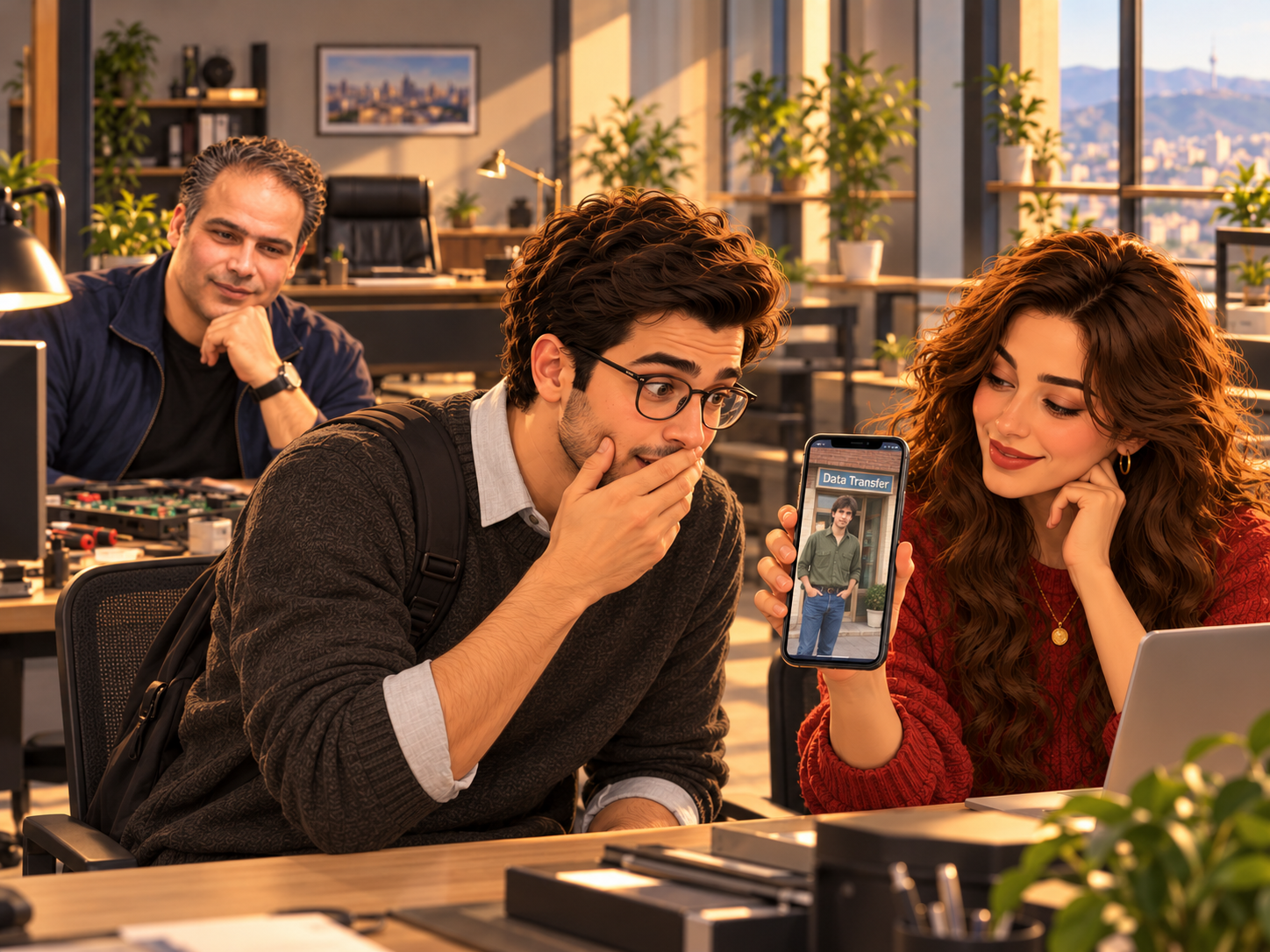
After Gela left, Mari picked up her phone. "Now that you've closed the manager's case, take a look at this too."
On the screen was an old photo: a younger Morteza was standing in front of a small office. Above him, the Data Transfer sign was visible. On the stand next to the door, there were images of communication equipment and services from that era.
Nika enlarged the photo. "Is this him?"
"Yes. The year 2016."
"So the company's name wasn't originally NetCity?"
Morteza, who had returned to the table, replied: "I entered Georgia in late 2015. In 2016, we registered our activities under the name DataTransfer. The company's name became NetCity in 2018. The work gradually changed as well."
Nika focused on the image. "Phone, communication equipment, controller... you were working on hardware back then?"
"Back then, we had more communication projects and technical services. Later, elevator card controllers and GSM intercoms were also developed. Each had its own needs, and some are still in use in old buildings."
"And then the software was added?"
"Yes. The experiences of the customers and the issues we encountered every day gradually made us take the software development path more seriously. Kadrebi for human resource management and attendance, SkolaPlus for schools, and Rigi24 for various business sectors."
Nika asked, "Is Rigi24 also a fixed system for a specific type of organization like SkolaPlus?"
"Not exactly. Rigi24 is a collection of business features and modules; each business should use the appropriate section according to its needs. SkolaPlus is a comprehensive system specifically for school management. These two models shouldn't be confused with each other."
Mari showed another photo; a few people in an old office, a small exhibition, and an image of Morteza behind that large management desk.
Nika enlarged the last photo with two fingers. "Wait! The document has finally been found!"
Giorgi asked, "What evidence?"
"That Morteza has at least sat in the management chair once. I thought that chair was just for decoration!"
Morteza laughed. "Sometimes we have meetings or guests. But most of my time is spent behind the computer."
"Why? When you own the company, you can have others do all the work for you."
Morteza paused for a moment. "Because my main job is still design and programming. I handle the development of the company's software myself. But the product is not just code. My colleagues convey customer needs, handle sales, coordination, and support. None of these sections are complete without the others."
Mari said, "Sometimes a customer's sentence makes us see something we had assumed was normal for months, again."
Giorgi added, "And sometimes a customer wants something that it's still unclear whether it can be done with the current device or not; there we shouldn't just make strange promises to close a deal."
Luka said from behind his desk, "And then I have to explain over the phone why a promise that wasn't made hasn't been fulfilled!"
Nika laughed. "So it seems like everyone here works in their own way and in the end, we all connect with each other."
Morteza said, "Exactly. Of course, no one should be afraid to ask questions. If a decision is wrong, it should be brought up."
Nika let out a sigh of relief. "That's good. Because I still have about a hundred questions."
"I understand up to this point."
"And about that job offer from yesterday..."
"That's okay. Just next time, before making a job offer, ask if the person is the owner of the same company you're sitting in."
Mari laughed, and Nika wished someone had made software to help him recover from all his embarrassing moments.
Five twenty-seven; something that really concerns us.
Near the end of the workday, Mari finalized the note about the call with Tamar. It was recorded next to the school file that the misunderstanding regarding the documents had been closed in the internal follow-up of the school, and no financial or investigative action was needed from NetCity. Only the new request regarding the review of the access level of the medical section of SkolaPlus for coordination with authorized officials remained.
Nika said, "Interesting. We closed one case and opened a new one, but these two are not at all of the same kind."
"That's right. One was an internal school dispute; the other is a review of software settings."
Nika looked at the schedule for the next day's tasks. "And Tamar's husband, Archil, was also supposed to make a call."
Mari said, "Probably. But first, we need to hear his side. Maybe Rigi24's invoicing solution will solve his needs, or perhaps later the online store features will become important to him. Until we ask how his business operates, we shouldn't make a decision."
"So it's again issue first, then suggestion?"
"This phrase was repeated a lot today, but it seems it was necessary."
Giorgi closed his folders. Luka recorded the last customer follow-up response. Morteza was still at the technical desk; he was running another test and carefully observing its results. The official company hours were nearing their end, but for him, the day usually ended later.
Nika passed by the large management desk. The leather chair was still empty.
In the morning, he thought that the emptiness of that chair meant that no one was responsible in the company. Now he knew that responsibility was not necessarily where the name "manager" was written.
Mari said, "What happened? Don't you want to investigate the chair anymore?"
Nika replied with feigned seriousness, "No. This case has been closed."
"And the final result?"
"The desk was empty. It wasn't the manager who was missing."
Mari smiled. "You can write this one in your report today."
Nika picked up his bag, but turned back at the door. "Just one last question."
Mari and Giorgi said simultaneously: "What now?"
"If Archil calls tomorrow and asks about issuing an invoice, should we refer him directly to Rigi24?"
Mari replied: "No, detective. First, we ask what the problem is."
Nika nodded. "Got it. I promise I'll remember this one."
When the door closed, Mari's mobile screen lit up for a moment. A short message had arrived from Tamar:
"Thank you for following up today. I gave your number to Archil. He will call tomorrow."
Mari recorded the message in the relevant communication file, without mixing it with the school's confidential information.
The case of the blue envelope was closed.
But a new business, with a completely different issue, was on the line for tomorrow.
End of Chapter Seven: The Empty Desk
Continuation in Chapter Eight: "The Missing Order"
What We Learned from This Chapter
- Management is not always seen behind a specific desk; the responsibility of each individual and team coordination is important.
- Good systems allow customers to carry out their daily tasks without frequent contact with the company, but responsible support is still essential.
- Kadrebi can provide suitable solutions for shift management and attendance, depending on the local conditions; online, offline, and app-based registration devices should not be assumed to be the same.
- An offline elevator controller is not necessarily connected to the server; the actual capabilities of each device model should be explained.
- SkolaPlus is a comprehensive school management system, with educational features, attendance, and medical information based on access levels. Managing school finances is not the responsibility of NetCity or SkolaPlus.
- The existence of a receipt or proforma invoice alone is not proof of payment or evidence of accusation. Internal discrepancies should be reviewed by the responsible authority of that organization.
- Rigi24 offers various features for business tools; the choice between an invoice generator or a store builder should start from the actual needs of the customer.
Further information: netcity.ge | kadrebi.ge | skolaplus.ge | rigi24.ge


Tools and further reading
Explore the real services and related guidance behind this chapter:
Learning note: examples are illustrative, not a substitute for reviewing real records.