Before you begin
This story-led series teaches practical concepts in attendance tracking, school management, and business software. Each chapter presents a relatable situation, followed by takeaways and links to explore the tools further.
Important note: Characters, dialogue, and the names of individuals or client businesses in these scenarios—apart from explicitly identified real brands—are fictional or dramatized for educational purposes. This is not a factual account of a real case or an allegation against any person or company. NetCity, Rigi24, Kadrebi and SkolaPlus are real brands and services; their features may evolve.
What will you learn?
- CRM protects customer history, but only authorized staff should access private records.
- A pager with dead batteries or poor range does not replace an ordering workflow and clear responsibility.
- Rigi24 Restaurant, Loyalty Club, and Faktorsaz invoicing are separate modules.
- Browser notifications may fail on sleeping phones; assign someone to monitor active orders and requests.
- Reports support fair decisions, but attentive human service earns trust and repeat visits.
The Customer Who Was Lost
Thursday, 10:24 AM - The number this time was not a stranger.

Mari had not yet finished her tea when the office phone rang. A small window opened on her monitor. The caller's name, the building address, and a short note were displayed below: 'Gela Machavariani - Request for elevator controller and intercom renovation; follow-up after installation.'
Nika, standing by the table, said softly: 'Wait! You haven't even picked up the phone yet. How do you know who it is?'
Mari pointed to the screen with her finger. 'From the customer file.'
'So the program knows the person's name before saying hello?'
'It matches the phone number with the information we previously recorded. It's not supposed to read anyone's mind.'
Nika leaned forward slightly. Below Gela’s name were the date of his and Giorgi’s visit, the types of devices, permitted photographs of the equipment, a summary of previous calls, and the request status. He said in surprise, “So even if I’m not here, everyone else will know the story behind that wooden box.”
'Exactly. Just be careful that not everyone should have access to all this information. Only authorized individuals can see the files.'
Mari answered the call. "Hello Mr. Gela, good day to you."
From the other side, a man's laughter erupted. "Ms. Mari! This time I don't need to say which building I'm calling from, do I?"
Mari said, "I think it's no longer necessary. But please, how did it go?"
Ten years, two names, and one result
Mr. Gela seemed to have been waiting for this conversation for a long time. He said, "Since the technical team finished the work, every day one of the residents has a new question. And for the first time, I find the answer in the software!"
In the past few days, after the proposal was approved in the building meeting, the test controller inside the cabin had been replaced with a more suitable model. The new frame and the functional display were placed next to the panel of floor buttons. The residents' cards had been defined with independent IDs and access levels; there was no longer a need for everyone to copy from a single master test card.
The GSM intercom at the entrance had also been renovated. The new appearance and equipment were aligned with the building's main need, which was to contact the resident and open the door. The manager of the building and a few residents had been trained on how to use it.
Gela excitedly continued: "Now if a tenant leaves the building, I can deactivate that same chip's access. For the new person, I will register a separate chip. I don't have to send half the building looking for the master card!"
Nika, who was listening to the loudspeaker call with Mari's permission, chuckled. He muttered, "Finally, Ms. Natla is at ease."
Gela, as if he had heard, said, "Ms. Natla came yesterday and said this is the first time the building manager can accurately say who has what card!"
Then his tone became more serious. "The financial part was interesting for us too. We register the unit charges, see the payment statuses, create a charge invoice for each unit, and send reminder SMS messages to the residents according to the settings. Of course, we are still learning ourselves."
Mari said, "It's good that you've started the registration and tracking process. Just remember to keep the numbers, accesses, and SMS settings accurate yourself."
Gela asked, "I just have one question. If this display breaks down in five years, will we have to replace everything again?"
Mari replied, "Not necessarily. This equipment is designed and developed by our team in Georgia; they are not just imported ready-made devices with a company label on them. The circuit design, software, assembly, and service are done here. If, for example, the case, keypad, or display gets damaged and a compatible part is available, usually that part can be repaired or replaced. The cost of the part and service is also stated separately and transparently."
Gela said, "So for a broken screen, we don't need to order a special part from some unknown factory on the other side of the world?"
"In many common repairs, no. Of course, it depends on the model and technical conditions; no one should make a definite promise without seeing the device."
The man laughed. "How interesting. We had the device for ten years; we just realized its maker is right here in Tbilisi!"
Nika said calmly, "The company's name had changed in these ten years too."
Gela laughed. "Yes! I was initially looking for Data Transfer. In the end, that old number helped me find NetCity. This time I'll keep the number and file correctly."
When the call ended, Mari changed the request status to "completed - customer satisfaction confirmed" and added the installation training and support notes to the file.
Nika said, "So this time Mr. Gela's file is really closed."
Mari smiled. "The issue in the file is closed. Customer communication is not. If he has questions again someday, his history is here."
Nika stared at the screen for a while. Ten years ago, the devices had worked independently; this time, the relationship between the building and the company was supposed to continue independently of one person's memory.
From "Store" to "Two Balconies"
Giorgi arrived just at that moment. He had a notebook in hand and a map of Tbilisi open on his phone.
"Nika, are you ready today?"
Nika said, "Please don't tell me it's another elevator!"
"No. This time it's a restaurant."
"Didn't you say yesterday that a store had applied?"
"In the initial form, they wrote that they sell ready-made meals. But when I called, it turned out they have two restaurant branches and sell some of the food for takeout as well."
Mari said, "What was its name?"
"Two Balconies. Its owner is Irakli Kakhabridze."
Nika asked, "Why did he call?"
Giorgi said, "He says his customers have decreased. But during the conversation, I realized there's another problem: in the busy branch, the waiters are fighting over who has worked more."
Nika smiled. "After attendance, school, and elevators, we've arrived at the waiters' fights. It seems this city can't function without conflicts!"
Giorgi closed the notebook. "That's why we're going to listen, not just barge in and prescribe a solution."
Nika passed by Morteza's desk. He paused for a moment and said, "Morteza, we're going to the restaurant today. What do you suggest for lunch?"
Morteza lifted his head from the monitor. "Somewhere the food doesn't take long to arrive."
Nika laughed. "We need to check this one ourselves!"
Branch two - the smell of fresh bread and the sound of complaints
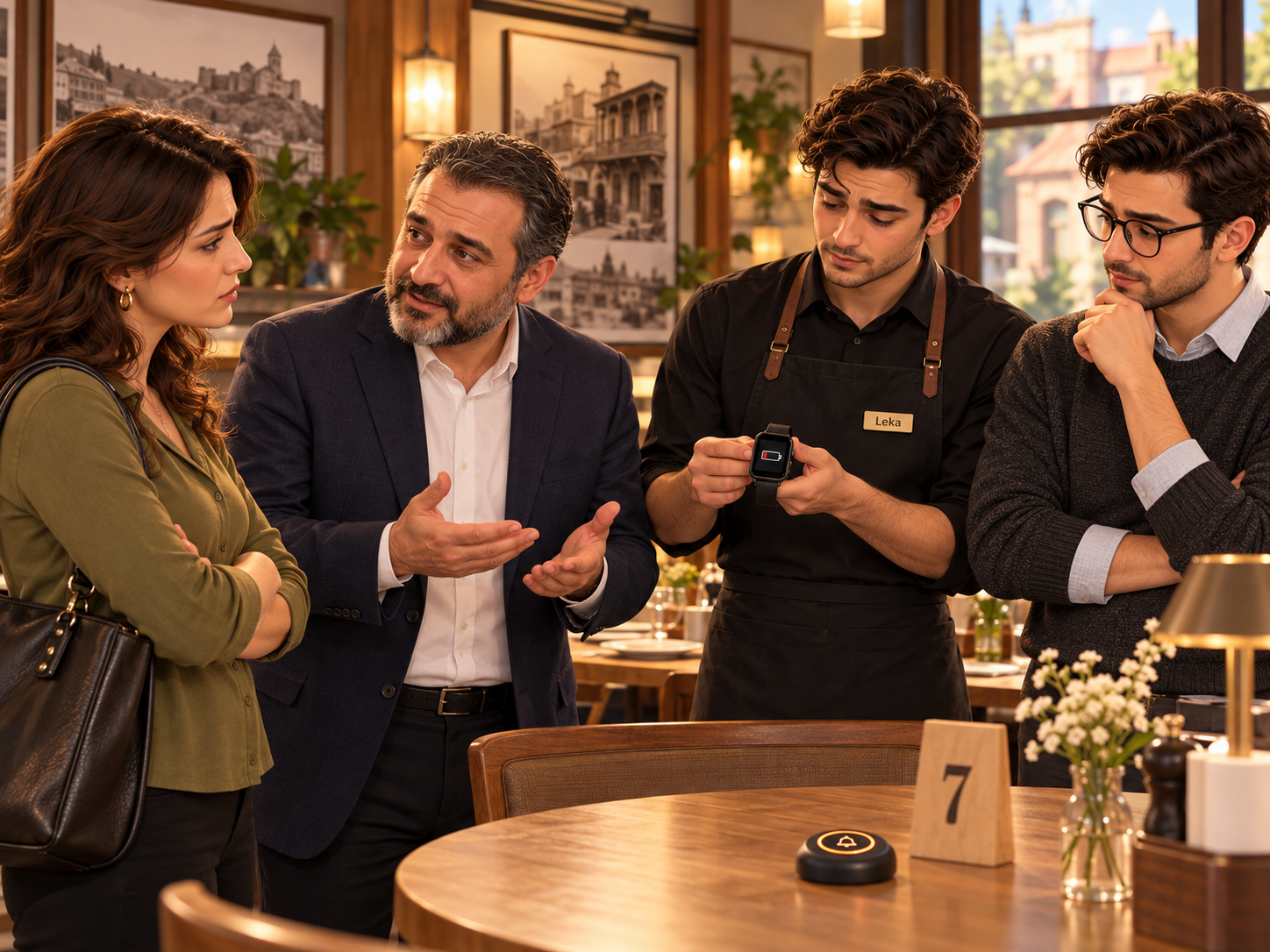
The "Two Balconies" restaurant had a pleasant atmosphere. Two floors, wooden tables, and windows that let the midday light fall on the bright tablecloths. On the wall, there were photos of old Tbilisi, and the kitchen at the end of the hall sent the sound of clattering dishes into the dining area every few minutes.
But something about that calm image didn't fit.
Next to the counter stood a woman in an olive dress with a dark leather bag. Her name was Keti. Her parents and two other family members were still seated at the table.
Keti turned to a man in a dark suit and said, "I have been a customer at your first branch for several years. I chose this place for my mother's birthday because I thought both branches treat customers the same way."
The man in the suit, who was Irakli, the owner of the restaurant, said, "Ms. Keti, you are completely right to be upset. Only the staff at the second branch do not have your history."
Keti replied, "It's not just about the history. We waited ten minutes for the waiter. We pressed the button twice."
Nika involuntarily glanced at Giorgi; it was as if they had entered a scene that would have been better started a few minutes later.
Irakli saw them and gestured for them to wait. Turning to Keti, he said, "Let me take care of your request right now. I apologize for the incident that occurred."
Keti calmed down a bit, but she was still dissatisfied. "I'm not looking for a discount. I just wanted my family to have a nice day."
Irakli ordered someone to attend to the table. Then he took Giorgi and Nika to a quiet corner of the hall.
"It's these kinds of incidents that make me not know what to do anymore. I have two branches and something goes missing every day."
The silent watch on the wrist
In the corner of the hall, a young waiter named Leka had taken off the calling watch from his wrist and was pressing the battery door with his nail.
Irakli said, "Leka, table seven has requested twice. Why didn't you go?"
Leka showed the watch. "I didn't receive anything at all. Look, it's turned off."
Nika asked, "Is this the same watch that vibrates when a customer presses the button on the table?"
Leka nodded. "Yes. Of course, if it has a battery."
Irakli sighed. "This is the second time this week. Another one broke a few days ago. Plus, sometimes there’s no signal at all at the far end of the hall."
Giorgi looked at the hall. The tables at the end were behind a low wall, and the distance to the service area was considerable.
Nika said, "So the problem isn't just the battery. A customer might press the button and no one would notice."
Leka said, "Worse than that is that sometimes the bells ring at the same time, but in the end, it’s unclear who should go. Either we all think the other one is going, or two of us go together."
Another waiter named Sandro — who was just a namesake of the restaurant employee from the first chapter — passed by them and said, "After the shift, Mr. Irakli will ask why I took fewer tables than you! How would I know?"
Irakli frowned. "I just want the work to be divided fairly."
Leka replied, "We want the same thing. But you don’t have an accurate report; it just seems like whoever is more visible has worked more."
Nika quietly said to Giorgi, "It's kind of like the Sandro situation and four minutes. Until the report is accurate, the judgment isn't accurate either."
Giorgi nodded. "But this time the issue is the request registration and the response time."
A button that only made a sound.
Keti came back to the counter. This time she was calmer. She asked, "Excuse me, can we order food? Or do we need to press that button again?"
Nika looked at the round device on the table. It had a plastic button with a bell symbol.
Irakli said, "Excuse me, my colleague is coming right now."
When Keti returned, Nika asked, "What exactly does this device send?"
Leka said, "Just that a table needs a waiter. It's not clear if it's called for an order, for water, or for the bill."
"So the customer can't choose their desired food from this device?"
"No. Even if they have the menu in hand, they have to wait for us and place their order verbally."
Giorgi wrote on the paper tablecloth by the window: "Waiter request ≠ food order."
Nika asked: "Why are you writing so seriously?"
"Because if we define the issue incorrectly, the solution will also be wrong. Irakli doesn't just want to change the broken clocks; he wants the entire ordering and response process to be clear."
Irakli said: "And at the end of the night, I want to know who received how many requests, which tables were delayed, and why."
A few minutes later, the food for table seven was finally ordered, but that delay was enough for Keti's mother's birthday to start with disappointment.
Two branches, two memories
Irakli took them to a small room behind the hall. On the table were two laptops and several folders.
"This file is for the customers of the first branch. The other one is for the second branch."
Nika asked, "So what happens to a customer who goes from this branch to the other one?"
Irakli said, "The same thing that happened to Keti. The first branch knows her, the second one does not."
Giorgi asked, "Do you have a loyalty card, points, or a customer club?"
"No, not in a proper way. For a while, we offered some seasonal discounts, and each branch had its own list. Right now, I don't know who really comes regularly and who only shows up when there's a discount."
Nika said, "So you don't even know how many times Keti has come, even though you say she's an old customer?"
"In the first branch, maybe one of the waiters remembers her. But if that waiter leaves, it's as if Keti is erased from the restaurant's memory."
Giorgi asked, "Do you think all customers will come back because of the lower prices?"
Irakli said, "I don't know. Until now, I've only been looking at the daily invoice numbers."
Nika said, "Maybe you don't have a shortage of customers; maybe you just don't know them."
Irakli looked at her. Then he gave a brief smile. "If that's the case, it's bad news. Because we wouldn't even realize who we were losing."
In Nika's mind, the name Gela came alive again; a building with a device that had been working for ten years and a connection that had been forgotten for ten years. Here, customers came to the restaurant, but their history got lost between the two branches.
A mistake called "everything in one place"
For the first time, Nika offered a suggestion of his own. "So let's put in a software that will fix the hours, take orders, recognize all the customers, and handle accounting. That's it!"
Giorgi laughed. "With that one sentence, you sold four separate projects to the customer!"
Irakli laughed too. Nika blushed a little. "Isn't it possible?"
Giorgi opened the notebook. "We can cover various needs with related tools, but their boundaries must be clear. For the table, QR menu, ordering, and waiter requests, we will review the restaurant module. For customer recognition and points, the loyalty club is a separate module. Faktorsaz is also a separate product; we’re not going to pretend everything is bundled together without configuration and separate costs here."
Nika muttered, "So instead of a magic box, we have several tools, each doing its own job."
Giorgi said, "Exactly. Plus, before launching, we need to ensure that the staff's workflow is clear as well."
Irakli asked, "So the customer at the table can see the food and order without calling the waiter?"
Giorgi said, "In the right scenario, by scanning the table's QR code, they enter the digital menu, see the photos and details of the food, and place their order. The waiter request or bill request has a separate path. The status of orders and requests must be tracked within the panel. But how each notification reaches the staff exactly needs to be designed and tested according to your device and work shift."
Irakli looked at him. "Why did you pause on the notifications?"
"Because I don't want to replace one problem with an unrealistic promise. On some phones, especially when the browser goes to the background or the screen locks, the web version notifications are not always guaranteed. We need to have a reliable method for busy shifts; for example, an active page and a designated person responsible for managing requests, so that a more suitable solution can also be explored."
Nika said, "So it's possible that the software is good, but if someone doesn't look at the screen, the customer will still be left waiting?"
Giorgi replied, "Yeah. Technology alone doesn't do people's jobs."
A map on a napkin
On the way back, Nika drew three columns on the restaurant's napkin.
At the top of the first one, she wrote: "Table"; below it: "Seeing food, choosing, ordering, requesting help or the bill."
At the top of the second one, she wrote: "Waiter"; below it: "Seeing requests, accepting, addressing, recording status."
At the top of the third one, she wrote: "Manager"; below it: "Seeing wait time, number of requests, and status of each branch."
Giorgi said, "That's good, but you're missing one more column."
"What?"
"The customer. Not the table. The person who comes back again."
Nika drew a fourth column and wrote: "Loyalty club, with the customer's consent."
Giorgi smiled. "And now don't mix up the two separate modules."
Nika gathered the napkin. "I'll keep this. Maybe one day we'll put it in the company museum!"
"Just write the date; otherwise, in ten years we'll lose it like Mr. Gela's file."
They both laughed.
A question about the silent man.
When they returned, Mari was busy preparing a response for a customer. Giorgi recorded the visit notes and Nika stood next to Morteza's table.
"Morteza, I have a technical question. If a customer orders from their phone, how can we ensure the waiter has noticed?"
Morteza looked up. "First, it needs to be clear where the order is being recorded, who is responsible for seeing it, and what happens if no one takes care of it. Just receiving a notification isn't enough."
Nika said, "So even you don't say the phone always notifies?"
Morteza smiled. "Why should I say something that doesn't always happen?"
Giorgi from the other side of the office said, "Well done. Write that sentence down!"
Nika turned to Mari and quietly asked, "By the way, what exactly does Morteza do? He has an answer for everything I ask."
Mari, without taking her eyes off the screen, said, "He's been working here for a long time. He knows the systems well."
"It's like a guidebook that can ask itself questions!"
Mari burst into laughter.
Nika continued: "There's one more thing; when Giorgi speaks, he has a sweet foreign accent, but he explains the issue more clearly than I do."
Mari said: "Well, Georgian isn't his mother tongue."
"I thought maybe that's why he's not very talkative."
"No, I think it's more because when he doesn't have anything to say, he doesn't speak."
Nika thought for a moment. "Oh no. Does that mean I'm exactly the opposite?"
Mari couldn't hold back her laughter.
Morteza said from behind the monitor, "What happened?"
Nika stood up straight. "Nothing! We were having a scientific discussion about the importance of silence in the workplace!"
Morteza said, "Then tell me the results of the research later."
Mari laughed out loud this time.
A decision that didn't start with advertising
That evening, Giorgi called Irakli. He had opened the restaurant file in the CRM and this time he knew exactly which problems needed to be addressed separately.
"My suggestion is to first test the ordering and table request method in one of the branches. Then, if the workflow for the staff improves, we can include the second branch in the plan. For the loyalty club, we should also specify the membership rules, points, and how to deal with old customers separately."
Irakli asked, "I want everything to change starting tomorrow. Is that not possible?"
Giorgi said, "We can hurry, but it might confuse the staff in the end and the customers will wait longer. It's better to proceed step by step."
Irakli paused for a moment. "Okay. First, the second branch; that's where the problem is greater."
Nika, who was listening to the conversation, wrote a note in his notebook: "A successful launch is not like flipping a switch."
The first test night
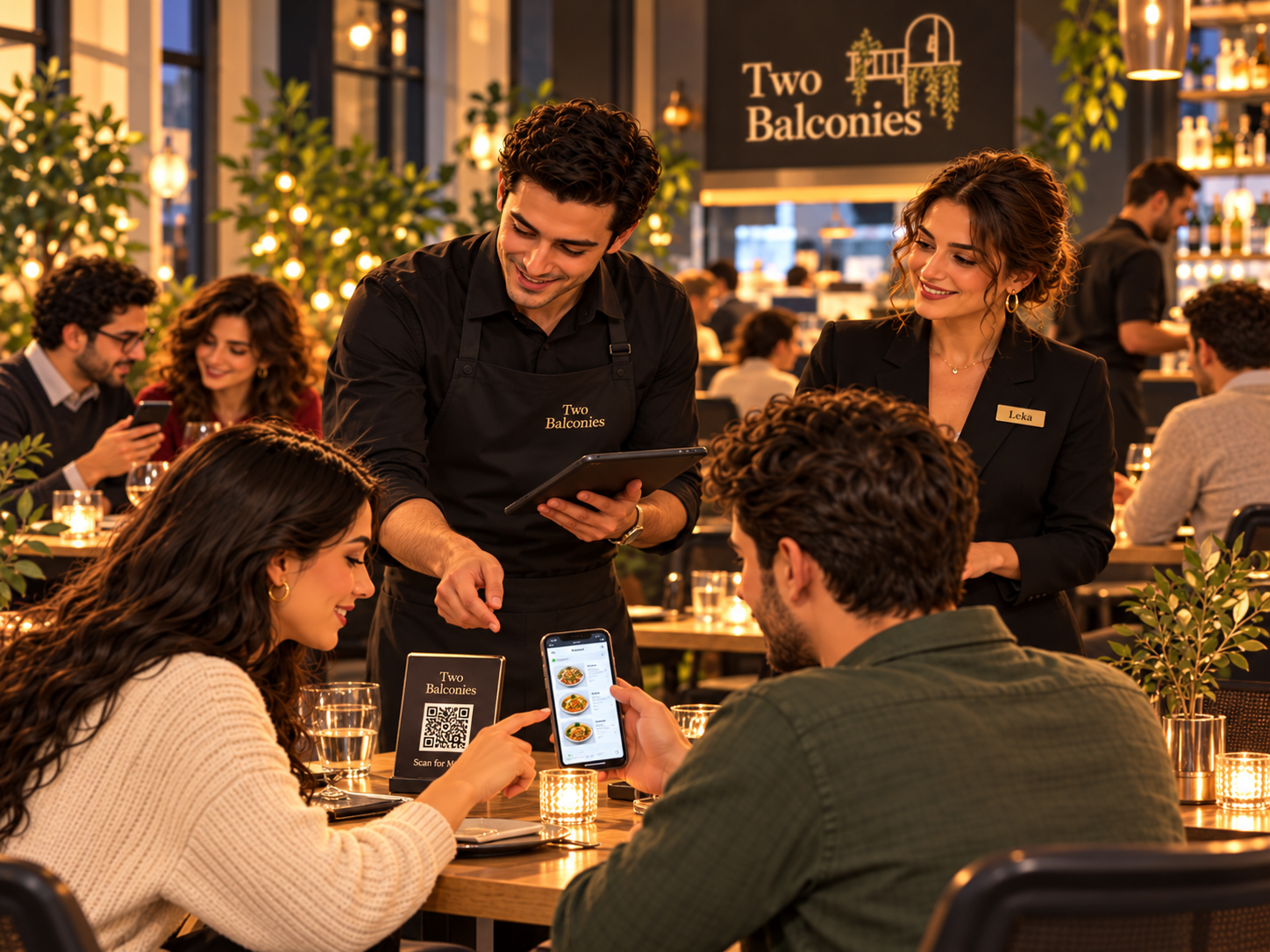
A week later, at seven-thirty in the evening, the second branch of 'Two Balconies' was busy. On the selected tables, there was a small card with a QR code, and the floor manager was monitoring requests next to a tablet that was kept on with its screen lit up.
Keti was not present that night. The goal of the test was not to surprise a specific customer; they wanted to first ensure how the system performs in real busyness.
Two young guests opened the menu with their phones. The images of the dishes and their descriptions were visible on the screen. One asked, "Is this dish spicy?" The other read the details and said, "It says here."
The order was registered. The floor manager saw it come in and informed the relevant waiter. Next to the table name, the status of the handling changed.
At another table, a customer sent a request for water; at the table by the window, a request for the bill was recorded. The floor manager saw these requests in the list and assigned the responsibility to handle them.
However, the first night was not without mistakes.
Leka forgot to mark the status of a completed request in the hustle and bustle. On the screen, that request remained open.
Irakli initially wanted to frown, but he remembered the discussion from the day of the visit. Instead of making a hasty judgment, he asked, "Did you handle it or not?"
Leka said, "I did. But I didn't press the completed button."
Irakli said, "So the work is done, but it's recorded incompletely. Both parts are important."
When the hall quieted down, they looked at the initial report. The recorded data showed which requests had been accepted, which ones remained open, and how long the response times had been recorded; but Irakli knew that one night and a few incomplete data points were not enough to judge people's performance.
A club that was not just about discounts.
A few days later, Mari talked to Irakli about the second phase. This time, the topic wasn't food and the waiter; it was the customers themselves.
Mari said, "For the two branches, you first need to determine how a member of the club is identified, what information is recorded with their consent, and what the rules for rewards are. If each branch sets a different rule, the same previous conflict will return."
Irakli asked, "So, does anyone who comes once automatically become a member?"
"No. Membership and the use of customer information must be transparent. The loyalty club is a separate module from restaurant management, and it needs to be activated and configured for use."
Irakli said, "So instead of giving everyone the same discount, can I define points and rewards according to specific rules?"
"Yes, according to the capabilities and plan you choose. The goal shouldn't be for everyone to always buy cheaper; the goal is to manage the relationship better."
Irakli wrote in his office, "A loyal customer does not equal a discount code."
He asked Mari, "Then what about Keti? We don't have her purchase information from previous years."
Mari said, "We shouldn't create or pretend to have an unrecorded history. You can talk to him respectfully, hear the past from him, and if he wants, include him from now on."
Irakli sighed. "I wish we had done this from the very beginning."
"The important thing is to do it right from now on."
Keti's return
On Tuesday evening, when the light on the windows of 'Two Balconies' had softened, Keti entered the second branch again. This time she was alone and intended to have a light meal before returning home; she wasn't there for a family celebration nor was she looking for a discount.
She sat at one of the tables near the counter. On the table, there was a small card with a QR code. Keti scanned it with her phone and saw a menu that displayed images and details next to the names of the dishes. Leka, who was in charge of that section of the hall that night, came over to answer any potential questions. Keti chose her meal and placed the order through her phone. After the order was processed, Leka checked its status with the hall manager.
After finishing her meal, Keti went to the counter to inquire about a new reservation. Irakli saw her and came forward himself.
"Ms. Keti, welcome."
Keti gave a faint smile. "I thought maybe you wouldn't recognize me."
Irakli said, "You had every right to think that. I apologize again for that day. We didn't handle it well."
Keti asked, "So now with the new system, everything is resolved?"
"No. We're still learning. But we have a clearer path for table requests, and it's not supposed to take an hour to determine who gets seen. We're also launching the club to recognize customers from both branches."
Keti said, "That's a good idea. But just one thing..."
"Go ahead."
"If the software recognizes me, that's good. But the restaurant staff also needs to recognize me."
Irakli smiled. "I'll mention this in today's staff meeting."
Keti said, "And one question. Can we reserve again for my mother's birthday?"
Irakli said in surprise, "But her birthday has already passed."
"Yeah. That day, because of the crowd, we couldn't celebrate the way we wanted. I want it to just be the five of us this time. No rush."
Irakli looked at her for a moment, then said, "We'd be happy to prepare a suitable table for you. But first, let’s coordinate the time and conditions precisely; this time I can't promise that we can do it."
Keti laughed comfortably for the first time.
Who was missing?
That night, Irakli sat behind his small office desk. The daily sales statistics were on the monitor; the same numbers he had been looking at every night for years.
Next to it was a list of handled requests and notes for staff training. The loyalty club had just started, and it was still too early to draw any conclusions about customer return.
He opened his old paper notebook. On a page, he had hastily written: "Customer numbers have dropped. Should we lower the prices?"
He stared at the sentence for a while.
Then he wrote underneath: "First, let's understand who and why they aren't coming back."
His phone rang. It was Giorgi.
"Hello Mr. Irakli. I wanted to check how the shift went tonight."
Irakli said: "It could have been better. We still have issues; some people aren't recording the work status correctly. But at least I can figure out where to ask questions."
Giorgi said: "That's a good start in itself."
Irakli paused. "You know, I thought my customers had disappeared."
"So what do you think now?"
"I think sometimes it was us who didn't see them."
Giorgi said nothing. It wasn't necessary.
Thursday, 18:03 - Office door
Nika was getting ready to leave. He passed by Morteza's desk; the same back desk with small boards and a lit monitor.
She said: "Hope you're not too tired. Today I learned that a bell that doesn't ring might get a customer from a restaurant."
Morteza said: "And a bell that does ring doesn't necessarily mean someone is responsible for answering it."
Nika smiled. "Do you always say the last sentence?"
"No. Sometimes it's Giorgi's turn."
Nika laughed and started walking. At the threshold of the exit, he turned back. "By the way, I think one day you should get up from behind that monitor and come to the restaurant!"
Morteza gave a short smile. "For now, you're doing a good job reporting."
Nika thought to himself that this old colleague, although not very talkative, answered in a way that made one’s next question even more pressing.
She went down the stairs. The office behind her quieted down; however, outside that building, people were still ordering food, using the elevator, going to school, and sometimes waiting for someone to actually listen to them.
End of Chapter Four
What we learned in this chapter
1. A customer's history, address, devices, visits, and calls can be recorded in the CRM with proper access rights so that it doesn't get lost with staff changes.
2. The access control devices and intercoms of NetCity are designed and developed in Georgia. Replacing parts such as the casing, keypad, and display, if technically feasible, may be more suitable than replacing the entire product.
3. Traditional pager or call clock equipment may cause delays and discrepancies among staff due to battery depletion, malfunction, insufficient range, or unclear request distribution. These devices do not inherently provide food ordering and comprehensive management reporting.
4. The Rigi24 restaurant module is used for the QR digital menu, viewing photos and specifications of dishes, placing orders from the table, and requesting a waiter or bill, as well as tracking requests in a specified workflow. The method of receiving notifications should be checked according to the phone and screen status; background notifications are not guaranteed on all devices.
5. The loyalty club is a separate module; its membership rules, points, and rewards require business decision and customer consent. Faktorsaz is also an independent module and is not considered part of the automated features of the restaurant module.
6. The software report does not replace training, respectful behavior of staff, and fair examination of events.
Tools and further reading
Explore the real services and related guidance behind this chapter:
Learning note: examples are illustrative, not a substitute for reviewing real records.