Bookings from Instagram, WhatsApp, Phone or Website? How to manage every customer request in one system
A complete guide to multichannel booking management: centralize Instagram, WhatsApp, phone, Google, website, walk-in and online bookings in one calendar and CRM.
Today customers do not contact a business through one fixed channel. One sends an Instagram message, another writes on WhatsApp, another calls, another walks in, another finds you on Google, another enters through your website, and some book directly online.
The problem begins when each booking remains in a different place: Instagram Direct, WhatsApp, paper, a receptionist's mobile calendar, Excel, or a booking system. It may look manageable at first, but as customer volume grows it quickly becomes disorganized.
Customers do not need to enter through one specific channel
The goal should not be to force every customer to communicate through only one channel. Customers should use whichever method is easiest for them: Instagram, WhatsApp, phone or online booking.
The key issue is not the communication channel. The key is that after a request is received, the customer and booking information must be registered in one central place.
Instagram is a communication tool, not a booking-management system
Instagram is excellent for marketing, showcasing work and communicating with customers, but Direct Messages were not designed to manage a business calendar.
A customer may ask whether 3 PM tomorrow is available, the receptionist confirms it, and if that appointment remains only in Direct another caller may receive the same time. The problem is simple: the Instagram booking never reached the main calendar.
WhatsApp is not a CRM or a calendar either
WhatsApp is excellent for direct conversations, but a busy business may have hundreds of chats. It becomes difficult to know who booked which service, for what date, with which provider, whether the time changed, whether it was cancelled, or whether the person is already an existing customer.
WhatsApp is great for conversation; business operations still need a central system.
Phone bookings are still very important
Some customers simply prefer to call and ask whether there is availability this afternoon. That is completely normal. Rigi24 is not meant to eliminate phone calls.
The receptionist can create the phone booking directly in Rigi24. The booking source is Phone, but the appointment itself appears in the same central calendar.
Do not forget walk-in customers
Some customers arrive without a prior booking: in salons, clinics, repair shops, restaurants or service centers. If a service or appointment is created for them, that activity should also be registered in the system so it is not lost from reporting.
What is the real problem?
The real problem is not the number of channels. The problem is turning every channel into a separate booking system: Instagram as one booking book, WhatsApp as another, phone as another, paper as another and Excel as another. Sooner or later this structure creates errors.
How does double booking happen?
Imagine only one provider is available at 15:00. A customer requests that time on WhatsApp at 10:00 and the receptionist confirms it but forgets to add it to the calendar. At 11:00 another customer calls, the calendar still looks empty, and the same time is confirmed again.
Now two customers have the same time. That is Double Booking: a few seconds of disorganization can create serious customer dissatisfaction.
You need one central calendar
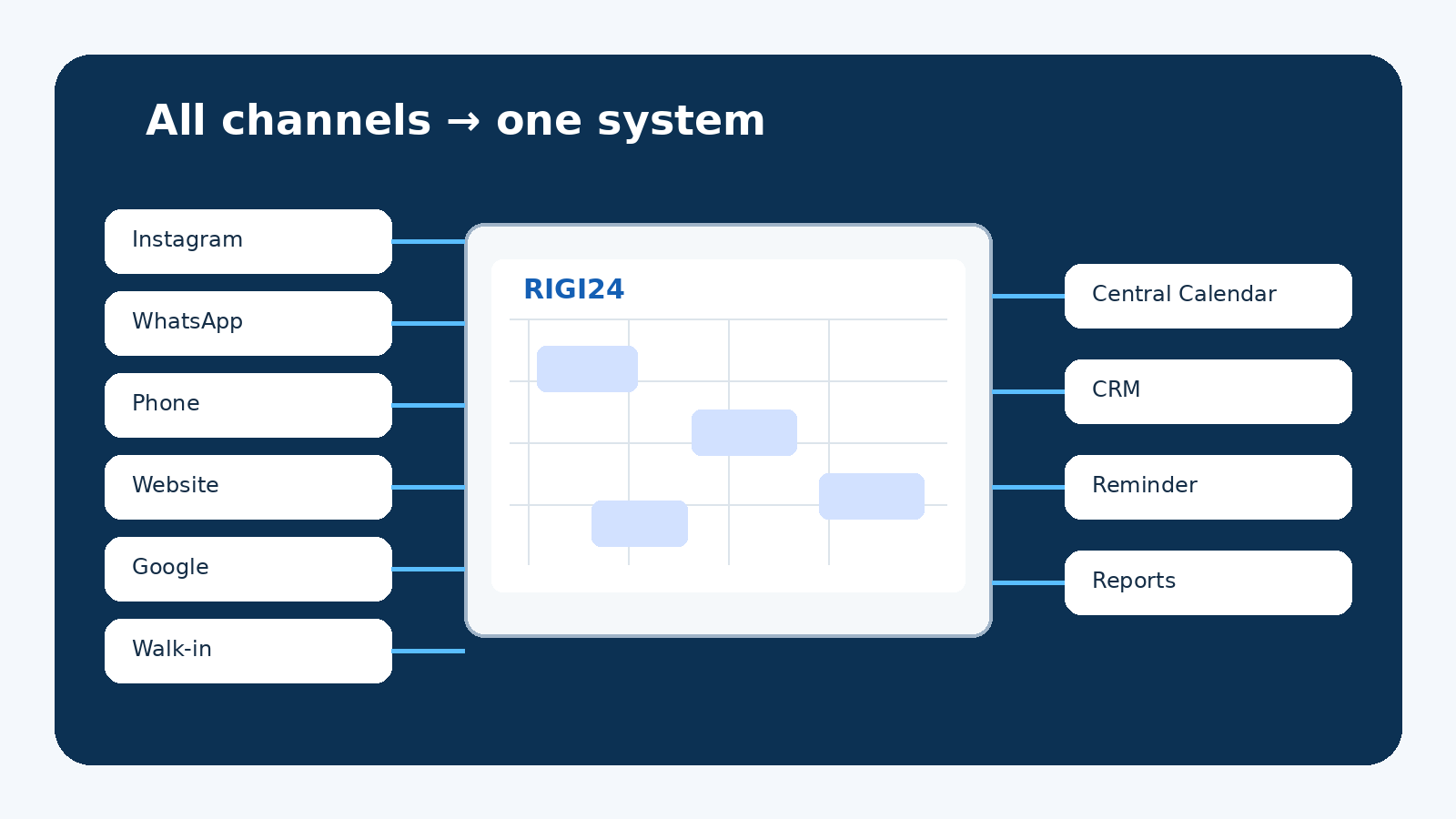
The solution is simple: no matter where the customer came from, the final confirmed appointment must enter one central calendar.
Instagram → Rigi24
WhatsApp → Rigi24
Phone → Rigi24
Walk-in → Rigi24
Website → Rigi24
Google → Rigi24
Online Booking → Rigi24
Everything is ultimately visible in one system.
The receptionist can create the booking for the customer
A booking system is not useful only when customers book by themselves. If a customer calls, the receptionist can collect the name, phone, service, provider, day, time and notes, and create the appointment in Rigi24.
From that moment, it behaves like any other booking in the system.
What happens after a booking is registered?
It can be viewed in the calendar, its status can be changed, the provider can be assigned, notes can be stored, time can be rescheduled, the customer can be notified, history can be viewed later and data can be included in reports.
A central CRM for customers
A customer may contact you through Instagram today, WhatsApp three months later and phone six months later. If those interactions live in separate systems, staff may repeatedly treat the same person as a new customer.
With a CRM keyed to the customer, staff can see first visit, previous services, past bookings, cancellations, No-Shows, notes and related interactions.
The mobile number can be the customer identity key
When the receptionist enters a phone number, the system can check whether the customer already exists. If yes, the existing profile appears; if not, a new customer is created. This prevents duplicate profiles.
Why are customer notes important?
Important details may be mentioned during the initial conversation: the customer will arrive 10 minutes late, wants the same provider as before, requires wheelchair access, or a vehicle has a specific sound from the front wheel.
If those details remain only in WhatsApp, the provider or manager may never see them. Notes keep the information attached to the appointment itself.
Rescheduling
“Can we change the time?” is one of the most common requests. When the booking is in a central system, the receptionist can update the time and the new state appears in the calendar. The customer can also be informed.
Cancellation
Cancellations should also be registered structurally, not crossed out on paper or lost in a deleted message. Later the manager can analyze how many appointments were cancelled, which services are cancelled more often, and on which days or times.
Reminders are useful for phone bookings too
Reminders are not only for customers who booked online. If a phone booking is entered in Rigi24 with a phone number or email, that appointment can also participate in the reminder workflow.
SMS and Email
Depending on business settings, notifications can be sent by SMS, Email or other channels for events such as booking created, confirmed, rescheduled or cancelled.
Providers and specialists
In a business with multiple providers, the time alone is not enough. The system must know who is delivering the service: Nino for Hair, Mariam for Nails, Dr. Giorgi for Dentistry, and so on. A central system makes provider capacity and availability much clearer.
Concurrent capacity
Some businesses can serve several customers at the same time, such as a salon with four specialists or a clinic with multiple active rooms. Capacity must be managed centrally; scattered Instagram and WhatsApp messages make that almost impossible.
An important distinction: acquisition channel vs. management channel
A customer may have discovered the business on Instagram, while the booking itself is managed in Rigi24. These are two different concepts: Customer Acquisition Source and Booking Management System.
What is Booking Source?
It is useful to record where each booking came from: Rigi24, Phone, WhatsApp, Instagram, Google, Website, Walk-in, Referral or Other. It looks simple at first but becomes highly valuable later.
Why is Booking Source important?
Imagine 300 bookings in one month: 90 from Instagram, 70 by phone, 50 from Google, 40 from Rigi24, 25 from WhatsApp, 15 from the website and 10 walk-ins. The report answers a crucial question: where are my customers actually coming from?
Better marketing decisions
If you spend heavily on Instagram ads and the data shows a large share of real bookings come from Instagram, that is useful evidence. If Google produces more customers, your marketing strategy may need to change. Without source tracking, decisions are mostly guesses.
Referral can be measured too
Many businesses grow through recommendations from existing customers. Recording Referral as a source helps measure how much growth comes from word of mouth and can later support a referral program.
Many customers start with searches such as “Dental clinic Tbilisi”, “Beauty Salon Tbilisi” or “Car Service Tbilisi”. If the Rigi24 booking link is placed in the right path, a customer can move directly from discovery to booking.
Website
A business with its own website does not need a separate booking engine. A Book Now button can send customers to Rigi24, while the website remains responsible for brand presentation and Rigi24 handles booking operations.
Instagram Bio
If many customers come from Instagram, the Rigi24 profile or booking link can be added to the Bio. Customers can view available times themselves instead of always asking in Direct. If they still prefer Direct, staff can create the booking manually.
The same logic applies to WhatsApp. Staff can reply with a booking link and let the customer choose a time, or create the booking on the customer’s behalf. In both cases, the central calendar stays consistent.
QR Code
A QR code can be placed on the reception desk with a message such as Scan to book your next appointment. The customer scans it and opens the booking page.
Email Signature
The booking link can even be placed in an email signature as Book an appointment, giving customers a direct path to scheduling after reading an email.
Social media is not being removed
A booking platform does not mean the business should stop using Instagram or WhatsApp. These channels remain important for marketing and communication. Rigi24’s role is to organize the result of the communication.
You do not need one communication channel
The main principle of this article is simple:
You do not need one communication channel; you need one management center.
Customers can enter from wherever they prefer, while the business maintains one view of customers and bookings.
Example: beauty salon
A salon may receive daily bookings from Instagram, WhatsApp, Phone and Rigi24. If each booking is entered immediately into Rigi24, reception checks only one calendar instead of switching among four applications.
Example: clinic
One patient calls, another books from the website, another comes from Google and another from WhatsApp. For the doctor and reception team, what matters is having one accurate list of today’s patients.
Example: repair shop
A customer writes on WhatsApp: “Do you have time tomorrow to inspect the brakes?” Reception can find the customer, choose Car Diagnostics or Brake Inspection, set the time, store the customer’s note and create the appointment. When the car arrives, the initial information is already recorded.
Example: consultant
A consultant may receive customers through LinkedIn, Website, Email, Phone or Referral, but all meetings are easier to manage when they appear in one central calendar.
Multiple reception employees
The problem becomes more serious when several employees answer customers: one manages WhatsApp, another answers the phone, another monitors Instagram. Without a central system, each person sees only part of reality. With Rigi24, staff can share the same calendar according to their permissions.
Reception shift change
If a morning receptionist books something on WhatsApp and then goes home, the next shift may know nothing about it if the booking exists only on that employee’s phone. Once it is in the system, shift changes are no longer a problem.
Remote manager
A central system also means the manager does not need to call reception just to understand the day’s schedule. The booking status can be viewed directly from the panel.
Daily report
At the end of the day the business can review how many bookings existed, how many customers arrived, how many cancelled, how many were No-Show, which channels produced bookings and which services were requested most.
Monthly report
The same data becomes even more valuable over a month. Instead of saying “I think Instagram brings more customers”, the manager has actual data.
Booking Source should be editable
Staff can occasionally register the wrong source, so managers or authorized users should be able to correct it.
Automatic source for online bookings
If the customer books directly from Rigi24, the source can automatically be recorded as Rigi24. In the future, links from websites or campaigns can carry more detailed source information.
UTM and advertising campaigns
At a more advanced stage, links can include campaign parameters such as Instagram Ad, Facebook Campaign, Google Ads or Email Campaign. Then the business can understand not only which platform produced the customer, but which specific campaign.
Why is this data valuable?
Advertising costs real money. If you do not know where customers came from, you do not know which marketing effort actually produced results.
Connection with CRM
Source is not useful only for individual bookings. It can also become part of the customer CRM profile: first acquisition source, first booking, total bookings, last visit, and later even Customer Lifetime Value analysis.
What role does Rigi24 play?
Rigi24 is not trying to become Instagram, WhatsApp or a telephone system. Its role is different: once a customer enters through any channel, business operations from that point forward become organized.
The ideal path
Instagram → customer asks a question → reception replies → booking in Rigi24 → SMS/Email Confirmation → Reminder → customer arrives → Completed status → Review → history in CRM.
This is a manageable cycle.
What if the customer books by themselves?
Google / Instagram / Website → Rigi24 Booking Page → choose service → choose provider → choose time → enter information → booking → Confirmation → Reminder.
The goal is not to remove people
Reception staff are important in many businesses. The system is not designed to eliminate them; it is designed to make their work more organized by keeping all important information in one place.
Benefit for the customer
Fewer incorrect bookings, fewer double bookings, fewer forgotten appointments, less contradictory information and less waiting for answers all improve customer experience.
Benefit for employees
Providers know who is coming, for which service, at what time and whether there is a special note.
Benefit for the manager
The manager can finally run the business based on real information instead of guesses.
Should customers be forced to book online?
No. A business may have 70% phone bookings, 20% WhatsApp and 10% online. That is perfectly acceptable as long as all bookings ultimately enter the central system.
When does online booking grow?
When customers discover that online booking is easier than sending messages, waiting for replies, asking about available times and waiting again, many will naturally choose the self-service option.
Freedom of choice for the customer
The better model is: Online Booking available — Human booking also available. Technology is an option, not an obligation.
Small businesses need this organization too
A two-person salon can also face conflicts if it receives dozens of daily messages. A central system is valuable when information matters, not only when the company is large.
Growth becomes harder without a system
Manual methods may work with five bookings a day. At twenty bookings, multiple providers and several communication channels, the difficulty grows quickly. A structured system makes growth easier to manage.
A simple Business Source Report
Booking Sources — August
Instagram — 34%
Phone — 26%
Rigi24 — 18%
WhatsApp — 12%
Google — 6%
Website — 3%
Walk-in — 1%
This report shows customer behavior in seconds.
Conversion can also be measured
If lead volume is tracked later, the business can compare inquiries with bookings. For example: 100 Instagram inquiries, 35 bookings, Conversion = 35%. This is the next level of marketing analysis.
What information is needed at booking time?
Depending on the business: name, mobile number, service, date, time, Provider, Source, Note and other genuinely necessary details. The form should not be made long without reason.
Do not ask for unnecessary customer information
The more complicated the form becomes, the higher the chance that the customer abandons it. Collect only what is actually needed to deliver the service.
One system, multiple entry paths
The architecture is simple: multiple inputs, but one management center. That is exactly what a multichannel business needs.
Multichannel booking management checklist
✅ WhatsApp active
✅ Phone answered
✅ Website link available
✅ Rigi24 link placed in channels
✅ All manual bookings entered in Rigi24
✅ Booking Source recorded
✅ Duplicate customer profiles avoided
✅ Notes stored inside appointments
✅ Central calendar used
✅ Correct provider assigned
✅ Confirmation handled
✅ Rescheduling and cancellation recorded
✅ Reminder enabled
✅ Final appointment status recorded
✅ Source report reviewed
If you make only one change today
Give every reception employee one simple rule:
No confirmed booking should remain only inside a message, phone call or piece of paper.
Every confirmed appointment must enter the central calendar. This single rule can eliminate a large amount of operational disorder.
Summary
Today’s customers are multichannel. They may discover you on Instagram, ask questions on WhatsApp, book by phone, read your website and book online next time. That is normal.
You do not need to force them into one path. What you need is one central system that manages the result of all those interactions.
Rigi24 can be the central point for customer and booking management without removing the channels your business already uses.
Instagram for visibility. WhatsApp for conversation. Phone for direct contact. Website for brand presentation. Google for discovery.
And Rigi24 to turn all of those paths into one customer, one booking and one organized calendar.
One communication channel is not enough. One management center is necessary.
Rigi24 — Book. Manage. Grow.
Related Rigi24 Academy articles
- Even if your customers do not book online, why do you still need appointment management and CRM?
- What is CRM and why do even small businesses in Georgia need it?
- How to build a Rigi24 business profile that attracts more customers
- What is a no-show and how can service businesses reduce missed appointments? 10 practical strategies