From Paper Notes to Traceable Stock: a Small Tbilisi Retailer’s First 30 Days
A practical transition starts with one rule: every physical item must become a named system item before it can be counted reliably. Consider a small Tbilisi retailer selling household goods and stationery from a shoproom and a backstore. On paper, the team may know that “blue notebooks” are present, but the system needs a precise item identity such as Notebook, A5, 96 sheets, blue cover. In the first week, the retailer should stop using vague labels, because vague labels create duplicate records, accidental mixing of variants, and unusable counts.
A workable first month is usually simple and disciplined. First, list the current assortment. Second, unify names and units of measure. Third, assign one warehouse and internal location structure. Fourth, count the stock physically and load opening balances only after validation. In a small store, that process can be completed in segments: category by category, shelf by shelf, instead of trying to rebuild everything in one evening. If 240 units of one item exist physically but 260 units are recorded, the discrepancy must be explained before sales continue against the new record. Otherwise, the system only digitizes the error.
SKU Catalogue Design: Naming, Identity, Variants, and Units of Measure
A clean catalogue is the backbone of smart inventory. Each stock-keeping unit should represent one sellable or stockable identity, not a loose family of products. The catalogue should answer five questions consistently: what it is, which variant it is, how it is counted, whether it is purchased or sold in another unit, and whether it can be mixed with similar items.
Build names that separate product family from variant
A useful naming policy often follows this pattern:
- Product family: Notebook
- Variant attributes: A5, 96 sheets, blue cover
- Optional commercial detail: hard cover, glued spine, lined pages
Avoid titles such as “Notebook blue” if the same supplier also delivers A4 blue, A5 blue, and spiral blue models. Those records look similar in a catalog search, but they are not the same item. If two items have different dimensions or sheet counts, they should usually be separate SKUs. The goal is not verbosity; the goal is stable identity.
Use units of measure deliberately
Units of measure must match operational reality. A box of pens may be purchased in cartons of 50, stored in packs of 10, and sold by each. The system should clearly define the primary stock unit and, if needed, conversion logic. A simple example: if 1 carton equals 5 packs and 1 pack equals 10 pens, then receiving 3 cartons should create 15 packs or 150 pens depending on the stock policy. If the business does not define that conversion, the same physical arrival can be entered three different ways, and the balance will become unreliable.
For small retailers, it is usually safer to start with one primary count unit per SKU and keep conversion rules only where they are unavoidable. Mixed units create confusion in receiving, counting, and shrinkage analysis.
GS1 identifiers: do not confuse item, location, and logistics unit
In a disciplined catalogue and location model, GS1 identifiers serve different purposes and are not interchangeable. A GTIN identifies a trade item: the product itself. A GLN identifies a legal or physical location: a warehouse, store, or receiving point. An SSCC identifies a logistics unit: a pallet, roll cage, or other shipping container.
That distinction matters in daily work. If a pallet of imported goods has one SSCC, the pallet label does not replace the item GTINs inside it. Likewise, a warehouse GLN does not identify the stock on a shelf; it identifies the site. The practical lesson is simple: the system should know what object is being identified before anyone scans or types a code.
| Identity layer |
Typical use |
Example |
| GTIN |
Product/item identity |
1 liter sunflower oil, brand X |
| GLN |
Site or location identity |
Tbilisi shop warehouse, receiving bay |
| SSCC |
Logistics unit identity |
One pallet wrapped for transport |
Receiving Goods: Counting, Exceptions, and Supplier Sign-Off
Receiving is where inventory accuracy is won or lost. A stable procedure begins before the truck arrives. The team should prepare the purchase document, the expected item list, and a receiving area with enough space to inspect quantities and visible damage. If the business receives mixed cartons, the first check should be the outer label against the expected SKU list, not the sales order alone.
Recommended receiving sequence
- Match supplier paperwork to the expected order.
- Count cartons, boxes, or loose units separately.
- Open sampling cartons when quantity or quality is uncertain.
- Record shortages, overruns, wrong items, or visible damage immediately.
- Mark what is accepted, what is pending dispute, and what is rejected.
- Obtain sign-off from the receiver and, when possible, the supplier driver or representative.
Suppose the retailer expects 100 units of detergent. The truck delivers 96 units and 4 units are visibly crushed. The correct response is not to “round to 100” for convenience. The accepted quantity is 96 only if those 96 are fit for sale, while the damaged 4 should be identified separately and placed into a damage workflow. If the supplier later agrees to credit the shortage, the note should preserve the original count, the discrepancy, and the resolution. This creates an audit trail that is useful even when the software is basic.
Partial deliveries should also be handled explicitly. If an order of 50 units arrives in two shipments, the first receipt should be posted as a partial receipt rather than closed as complete. Otherwise the system may show false shortages or duplicate balances. If the retailer uses the same modular ecosystem for procurement, warehouse, and invoice tasks, the principle still remains: document each physical receipt exactly as it occurred, then reconcile the paperwork later.
Warehouse Layout: Zones, Shelves, Bins, and Placement Discipline
Accurate stock records require a warehouse design that is simple enough for staff to follow under pressure. Even a small operation should separate locations by function: receiving, active storage, pick face, returns, damage hold, and scrap or disposal area. The point is not architectural sophistication; the point is location clarity.
Example of a practical location structure
- Zone A: Receiving and inspection
- Zone B: Fast-moving stock
- Zone C: Slow-moving reserve stock
- Zone D: Damaged or quarantined stock
- Zone E: Returns, repair, or supplier hold
Within each zone, shelves should be labeled and bins numbered. A shelf code such as B-02-03 can mean zone B, rack 02, bin 03. The exact format is less important than consistency. When every item has one home location, finding discrepancies becomes much easier. If a staff member moves a carton from B-02-03 to the counter for a sale preparation, that movement should be recorded as a movement, not treated as a silent relocation.
Do not overload one bin with many unrelated SKUs just because they are small. Mixed bins are a major source of miscounts, especially when similar items are repacked or when one variant is mistaken for another. The practical rule is: one bin, one primary SKU, unless the item family is tightly controlled and clearly separated by packaging.
Stock Statuses: On-Hand, Available-to-Sell, Damaged, Repair, Scrap, and Reserved
Small businesses often say “we have it” when they really mean “we can probably sell it.” Those are not the same thing. A disciplined stock model distinguishes the following states:
- On-hand: all physically present quantity recorded in the warehouse or store.
- Available-to-sell: quantity fit and intended for sale.
- Reserved: quantity held for a specific customer, transfer, or internal use.
- Damaged: quantity physically present but not sellable.
- Repair: quantity awaiting restoration or inspection.
- Scrap: quantity no longer recoverable for normal sale.
If 20 units are on hand, but 3 are damaged and 2 are reserved for a pending wholesale pickup, then the sellable quantity is 15. That distinction is critical for customer promises. A store may still physically possess 20 units, but only 15 should be considered available-to-sell. If the business records only the on-hand quantity, staff may overcommit stock and later disappoint buyers.
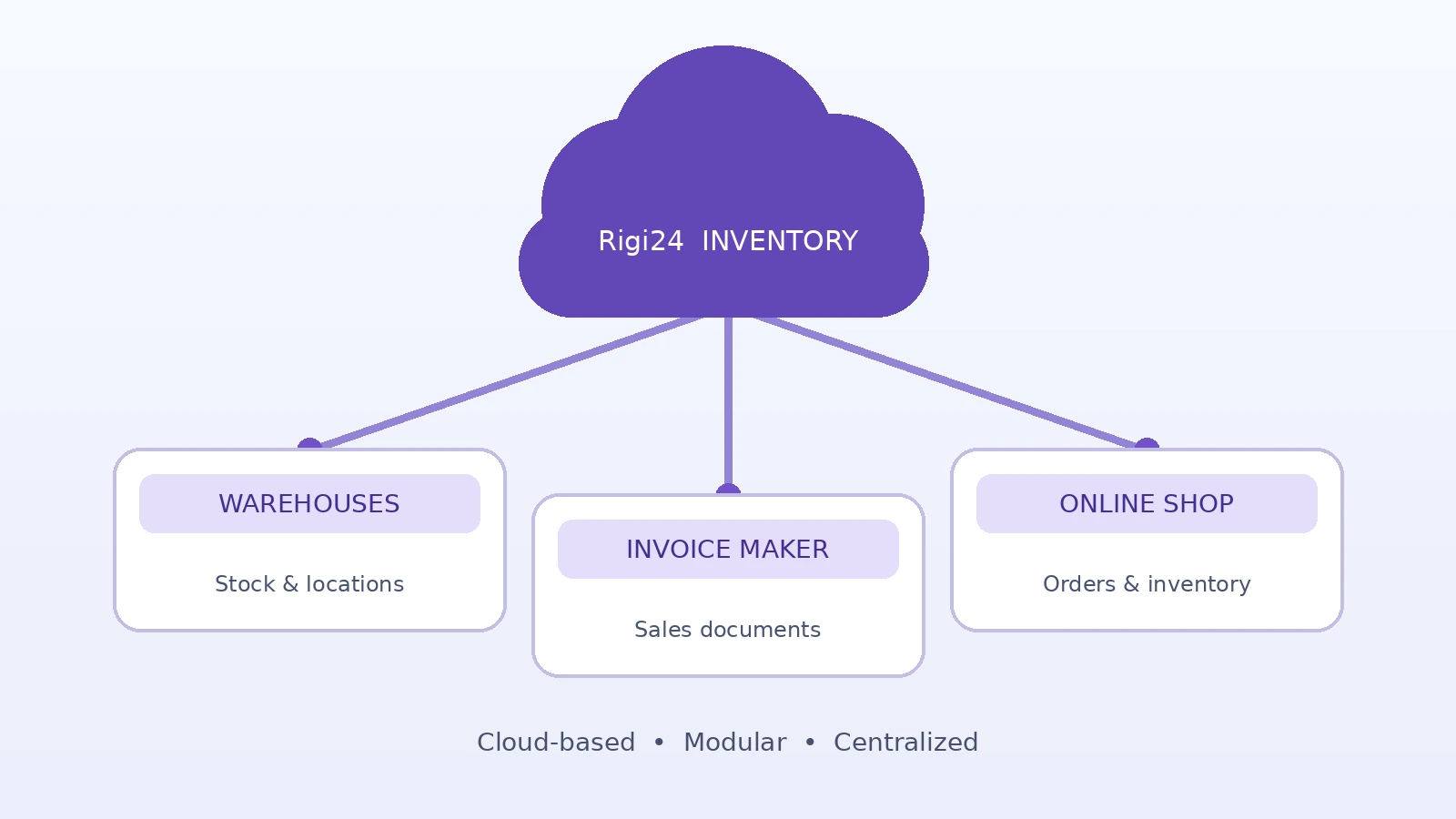
Rigi24’s inventory model includes items, warehouses, internal locations, movements, counts, damage, repair, and scrap. In practice, that structure supports the separation of physical states if the business uses those records consistently. What matters operationally is not a label in isolation, but disciplined classification at the moment of movement or count adjustment.
Traceable Movements and Physical-to-System Reconciliation
A simple traceable procedure should answer four questions for every movement: what moved, from where, to where, and why. For a small retailer, this can be done with a basic movement log and a weekly reconciliation routine. The procedure should not depend on memory.
Minimum movement record
- Item identity and unit
- Quantity moved
- Source location
- Destination location
- Reason code: sale prep, put-away, return, damage, repair, count correction, internal transfer
- Person who performed or confirmed the move
- Date and time
Example: 12 units of a charger move from reserve shelf C-01-02 to the counter staging area for same-day dispatch. The system should show that 12 units left one location and entered another. If 2 units are later found missing from staging, the reconciliation process can isolate when and where the count diverged. Without this chain, every shortage becomes a guess.
For reconciliation, count by location, not by memory. Compare system balance and physical balance for each bin or shelf, then classify the variance. Common variance causes include misplacement, unposted damage, unit conversion mistakes, and duplicate entries. A useful rule for small teams is to investigate any variance above a small threshold immediately, such as 1 to 2 units for high-value goods or 1 percent for bulk items. The threshold should be set by management, not by convenience.
Barcode and QR Codes: Lookup First, Movement Second
Barcodes and QR labels are most valuable when they reduce ambiguity. In many operations, a scan should first identify the item or location before any stock movement is approved in the process. That means scanning is a lookup tool and verification tool; it is not automatically the same as a valid inventory transaction.
This distinction matters. A scan may confirm that the user has found the right item, but a stock movement should still follow the warehouse procedure: select source, select destination, enter quantity, and record the reason. If a business treats every scan as a stock change, accidental scans will corrupt records. If it treats every scan only as a lookup, it loses operational efficiency. The right balance is controlled scanning within a defined procedure.
In a small store, a simple barcode label on the shelf bin and on the item package can speed checks. For example, when the clerk scans bin B-02-03 and then the item label, the system can display the item name, expected stock, and last movement date. The staff member then compares that record with the physical count. If the business later expands to another branch in Batumi or Rustavi, the same logic can be repeated with branch-specific locations, while the item identity remains the same.
Practical Control Checks for Managers and Supervisors
A lightweight control checklist helps keep the system honest without creating bureaucracy. Managers can use the following checks during the first weeks after implementation:
- Every SKU has one unambiguous name and unit.
- Every shelf or bin has a visible location code.
- Receiving notes show accepted, rejected, and damaged quantities separately.
- No mixed variant is stored in the same bin unless explicitly controlled.
- On-hand and available-to-sell are not treated as identical.
- All damage, repair, and scrap quantities are moved to the correct status.
- Physical counts are reconciled against system counts by location.
For a small Georgian retailer, these controls are usually enough to move from approximate paper records to a disciplined digital warehouse routine. The result is not just cleaner data. It is also fewer surprises at receiving, fewer stockouts caused by phantom balances, and fewer disputes with suppliers when the delivered quantity does not match the order.
Counting Variances: How to Investigate Before You Adjust
A stock count should not be treated as a bookkeeping formality. If the system shows 120 units and the physical count finds 117, while 2 units are visibly damaged, the first step is not an immediate correction. It is an investigation. Those numbers can mean several different things: one unit may be missing, one may have been counted in the wrong location, or one may already have been received into the warehouse but not moved into the correct status. In a disciplined process, damaged stock is not silently blended into healthy available stock, because on-hand quantity and sellable quantity are not the same thing.
In this example, the warehouse team should separate the issue into three questions. First, are the 117 physical units all in saleable condition? Second, are the 2 damaged units already recorded in a damage, repair, or scrap location? Third, is the missing difference explained by another movement, such as a transfer, receipt, or customer return entered on the same day? Only after these questions are answered should the adjustment be posted.
Practical variance check sequence
- Freeze the count area and record the exact location counted.
- List the item identifier, lot or serial references if used, and the count time.
- Check whether any pending movements exist for that item and location.
- Inspect damaged pieces separately and classify them as repairable, scrap, or unusable.
- Confirm whether the missing unit may have been mis-slotted or moved after the count began.
- Only then post an adjustment with a clear reason code or note.
If the business simply adjusts 120 down to 117 and ignores the 2 damaged units, the inventory record becomes misleading. The system may show fewer saleable units than are actually usable, while damaged stock may disappear from traceability. That creates downstream errors in purchasing, margin analysis, and reorder planning.
Cycle Counting Based on Risk, Value, and Turnover
Many small warehouses still count on a calendar habit: once a month, once a quarter, or at year-end. That approach is convenient, but it is not necessarily intelligent. A better cycle counting plan ranks items by risk, value, and turnover. High-value, fast-moving, and error-prone items deserve more frequent verification than slow-moving, low-value stock sitting untouched for months.
For example, a plumbing distributor in Georgia may keep brass fittings, pumps, filters, and replacement parts. The fittings may be low value but highly picked, so location errors are common. Pumps may be expensive but slow-moving, so the financial impact of a discrepancy is high even if counts are less frequent. Filters may turn quickly and should be checked often because they drive many small orders. A fixed monthly schedule ignores these differences.
A practical risk-based structure
- Class A: high value or high turnover. Count weekly or biweekly.
- Class B: moderate value or moderate movement. Count monthly.
- Class C: low value and slow movement. Count quarterly or after movement exceptions.
This is not a rigid formula. The real point is to align counting effort with the cost of being wrong. If a company finds repeated variances in one item family, that family should move into a higher-frequency count cycle until root causes are fixed.
Managing Multiple Warehouses with Location-Specific Balances
When a company operates two or more geographically distant warehouses, each site must maintain its own balances. A unit in Tbilisi is not the same as a unit in Batumi from an operational perspective, even if the item itself is identical. Managers should not rely on a single combined quantity unless they are deliberately viewing network-wide total stock. For replenishment and customer commitment, location-specific availability matters.
Good practice is to treat each warehouse as a distinct inventory node with its own receiving area, storage locations, damage area, repair area, and dispatch area. That structure makes it easier to know where stock physically is and what condition it is in. It also supports realistic transfer planning. If one branch has 40 units on hand but 10 are in damage and 5 are reserved for internal use, the sellable balance is only 25, even though the on-hand figure looks higher.
| Warehouse | On-hand | Damage | Repair | Sellable |
|---|
| Tbilisi | 40 | 10 | 5 | 25 |
| Batumi | 18 | 0 | 2 | 16 |
In this table, the network total is 58 on hand, but only 41 are immediately sellable. If a sales team sees only the network total, it may promise stock that cannot actually ship from the intended branch.
For GS1 terminology, the item itself is identified by the GTIN. The physical warehouse site is identified by a GLN if the business uses GS1 location identifiers. A shipping pallet or other logistic unit may carry an SSCC. These are not interchangeable. A GTIN describes the product, a GLN describes the location, and an SSCC describes a logistic unit that may contain one or more products.
Transfers Between Warehouses: Send, Receive, Shortage, and Responsibility
Inter-warehouse transfers are one of the easiest ways for stock records to drift if the process is not disciplined. A transfer should not be treated as a single event. It is at least four checkpoints: sending, transit, receiving, and exception handling. The sending warehouse should reduce its available quantity only when stock is actually dispatched, and the receiving warehouse should record the goods only after physical receipt is verified.
Consider a transfer of 50 units from Tbilisi to Kutaisi. The sending team counts and packs 50 units and records the dispatch. The receiving team counts 48 units on arrival. That shortage must be documented immediately. The business should not simply “average out” the difference or push it into general shrinkage without review. Was one unit damaged in transit? Was one left behind on the dock? Was the packing list wrong? Responsibility is assigned by facts, not assumptions.
Minimum transfer checkpoints
- Pre-dispatch count and item verification.
- Packaging or pallet identification, ideally with a unique reference.
- Dispatch record including date, sender, receiver, and quantities.
- Receiving count against the dispatched reference.
- Exception note for shortage, damage, or overage.
- Final posting to the destination warehouse balance.
Where possible, separate in-transit stock from on-hand stock so the same units are not counted twice or assumed available before they physically arrive.
Returns and Repairs: Keep Healthy, Damaged, and Repair Queues Separate
Returns are not a single inventory event. A full return may bring back the entire shipment, a partial return may involve only one of several items, and some returned goods may be resalable while others are not. If all returned items are dumped into one location, the warehouse loses visibility. The better approach is to separate healthy returns, damaged returns, repairable items, and scrap.
A customer may return 12 units because 3 were wrong sizes and 9 were unused. If the 9 are unopened and intact, they may go to a healthy returns location after inspection. The 3 wrong-size units may also be healthy stock if the packaging is intact. But if 2 units are physically damaged, they should move to damage or repair, not back to general stock. The point is to preserve condition status, not just quantity.
Useful return statuses
- Healthy return: fit for resale after inspection.
- Repair queue: unusable now, but may be restored.
- Damage queue: visible damage requiring decision.
- Scrap: no economic recovery expected.
This separation matters for reporting too. If repairable units are mixed with sellable units, sales forecasts become inflated. If damaged stock is left in the main warehouse balance, order promises become unreliable.
Online-Store Orders and Independent Invoices: Avoid Double Deduction
Where a business uses both online-store order entry and separate invoicing, the key rule is simple: the same physical stock must not be deducted twice. But the workflow depends on how the company is set up. It should not be assumed that an online order automatically reduces inventory in every system, and it should not be assumed that a manually issued invoice does so either. The operational requirement is that one transaction should be the source of truth for the stock movement, while the other documents the sale without duplicating the quantity change.
For example, if a customer places an online order for 4 units and the finance team later issues an invoice for the same 4 units, the warehouse should define which step triggers the inventory movement. A common best-practice pattern is: order acceptance creates a picking task, shipment confirms the stock reduction, and invoice records the sale value. If a second entry is made independently, the team must check whether it is a duplicate document or a separate transaction, not just post it blindly.
This is especially important in modular environments where the online store module and the invoice module exist in the same ecosystem but are still operationally distinct. The company should document whether stock is managed from order, shipment, invoice, or a combination of those steps. Without that rule, one customer order can produce two deductions and a false shortage.
Practical Purchasing: Reorder Points Without Inflated Forecasts
Purchasing decisions should be based on actual consumption and realistic lead times, not on optimistic guesses. If a product normally sells 20 units per week and supplier lead time is 3 weeks, the business should not reorder only when the balance reaches zero. It needs a buffer. But the buffer must reflect real demand, not an inflated forecast created by one unusually busy week.
A sensible reorder point can be built from average usage during lead time plus safety stock. If average weekly use is 20 units, lead time is 3 weeks, and safety stock is 15 units, the reorder point is 75 units. If the company currently has 82 units sellable, no purchase is needed yet. If 18 units are damaged and still counted as on-hand, however, the apparent balance of 100 units is misleading. Purchasing should be driven by sellable stock, not by gross stock.
One practical mistake is to raise reorder quantities every time the warehouse sees a shortage caused by poor counting or a delayed transfer. That turns an operational problem into unnecessary buying. Another mistake is to forecast demand from a single promotional spike and then overstock for months. Forecasts should be reviewed with sales history, seasonality, and known customer commitments, but not exaggerated to compensate for poor data discipline.
Four-Week Rollout Plan with Owner Checklist and Audit Log Review
A realistic rollout does not require a giant transformation project. A small or midsize warehouse can improve control in four weeks if ownership is clear. The key is to assign a process owner, define what will be measured, and review audit logs or movement history consistently. The exact interface depends on the system configuration, but the operational discipline should be the same.
Week 1: master data and locations
- Confirm item names, units of measure, and item codes.
- Separate warehouses and internal locations clearly.
- Identify damage, repair, scrap, and quarantine areas.
- Review whether each product’s sellable and non-sellable status is defined.
Week 2: counting rules and transfer discipline
- Write the count procedure for variance investigation.
- Define who can record movements and who reviews exceptions.
- Introduce transfer checkpoints and shortage documentation.
- Set a cycle count frequency by item risk class.
Week 3: transaction review and training
- Train staff on on-hand versus sellable quantity.
- Practice return, repair, and damage classification.
- Review sample audit logs or movement histories for missing notes.
- Check that invoices and orders are not causing duplicate deductions in the process design.
Week 4: control review and correction
- Compare counted balances with system balances.
- Measure variance rate by item group and location.
- Adjust reorder points using real consumption data.
- Document which errors came from process, not from software.
A useful ownership checklist for the warehouse manager is: Does every movement have a reason? Are damaged goods visible but separated? Are inter-branch balances realistic? Are returns and repairs isolated from saleable stock? Are invoice and order workflows defined so stock is not deducted twice? If the answer to any of these is no, the rollout is still incomplete.
Concrete Network Example: Distributor with Two Branches and a Service Desk
Imagine a network equipment distributor with a main branch in Tbilisi, a secondary branch in Batumi, and a service desk that handles repairs and replacements. The company sells routers, switches, and access points. The Tbilisi branch holds sales stock, the Batumi branch supports regional customers, and the service desk receives defective units from customers or internal testing.
One router model may show 30 units on hand in Tbilisi, but 6 are in repair and 4 are damaged awaiting decision. That means only 20 are sellable. Batumi may have 8 on hand, all sellable. The total network balance is 38 on hand, but only 28 are available for immediate sale. If a salesperson promises 35 units based on the network total, the company will fail one branch or force an emergency transfer.
Now add a transfer of 10 units from Tbilisi to Batumi. Tbilisi dispatches 10, but Batumi receives 9 because one carton was damaged and recorded separately. The service desk then inspects the damaged unit and places it into the repair queue. That one unit is neither lost nor sellable, but it must remain traceable. If the company’s processes are clear, the final stock picture is accurate: Tbilisi is lower by 10, Batumi is higher by 9, and 1 unit sits in repair. If the process is unclear, the same event becomes a mystery shortage.
That is the real value of smart inventory control: not just seeing quantities, but understanding condition, location, responsibility, and movement history well enough to make correct purchasing and fulfillment decisions.


 Practical inventory counting resourcesWarehouse Stocktaking and Cycle Counting: How to Resolve Inventory Discrepancies
 Employee communicationTeam Chat for Employees: Private and Group Messaging | Rigi24
 Tasks and remindersWorkspace and Task Management for Small Teams | Rigi24
 Related practical resourcesInventory Returns Management: Partial Returns, Damaged Goods and Stock Reconciliation