
Georgia’s official work-time file: Annex №2 and Rigi24 automatic XLSX export
What is Annex №2?Ministerial Order No. 01-15/ნ of 12 February 2021 approved the rules for recording working time in Annex №1 and the official work-time form in Annex №2. The regime took effect on 1 March 2021 and was later amended in 2022 and 2023. A monthly record that may be electronicThe work-time record is a monthly document and may be maintained on paper and/or electronically. Employers may use another format, provided the minimum required data is preserved. This is an important legal basis for properly design

What is Annex №2?
Ministerial Order No. 01-15/ნ of 12 February 2021 approved the rules for recording working time in Annex №1 and the official work-time form in Annex №2. The regime took effect on 1 March 2021 and was later amended in 2022 and 2023.
A monthly record that may be electronic
The work-time record is a monthly document and may be maintained on paper and/or electronically. Employers may use another format, provided the minimum required data is preserved. This is an important legal basis for properly designed digital HR exports.
Closing deadline
Under the general rule, the employer sets the closing date but it must be no later than the 10th day of the following calendar month. Later amendments created different timing for certain special groups, so sector-specific rules should also be checked.
Required information
The form covers the organisation, structural unit, preparation date, reporting period, identification code, employee name and position, personal/personnel number, daily attendance indicators, first-half and second-half totals, days worked, total hours, overtime, night work, holiday/rest-day work, remote/other hours, sickness, paid leave, unpaid leave, other absences and rest days.
Status symbols
Amended versions define standard symbols for several daily statuses such as absence, sickness certificate, paid leave, unpaid leave and rest/holiday. Compliance exports should therefore follow the applicable current template.
Shift workers
For shift work, the approved shift schedule should accompany the work-time record. If the schedule changes during the reporting period, the change document should also be retained. Attendance data without schedule context is therefore insufficient for robust compliance.
Retention
The final completed and signed monthly record must be retained for at least one year by the employer or the designated responsible unit/person. Responsibility for preparing, completing, retaining and providing access should also be assigned.
How Rigi24 generates Annex №2
Rigi24 HR Manager provides a dedicated Government Annex №2 XLSX export in the monthly Workforce report in addition to the management Excel. It uses attendance, schedules, leave, absences, night hours, overtime and other work-time categories and generates a workbook based on the official Matsne template.

Department-friendly workbook
Rigi24 can organise data by department with meaningful worksheet names, making large multi-department files easier to review, print and archive.
Why automation matters
Manual retyping from attendance records into spreadsheets creates duplication and error risk. Automatic generation reuses controlled source data and improves traceability.
Eight-language interface
Managers and employees can work in eight interface languages while the compliance-oriented output remains tailored to Georgian requirements.
Annex №2 is not just another spreadsheet
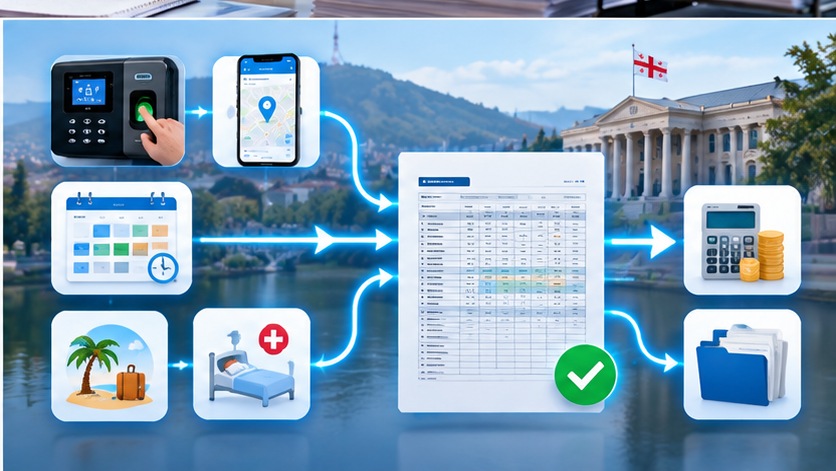
The official work-time form is the final output of a data chain: schedules, clock events, leave, sickness, night work, overtime, holidays and other statuses must be correct before the XLSX is generated. A perfectly formatted spreadsheet cannot fix incorrect source data.
Rigi24 therefore treats Annex №2 as the final stage of Workforce month-close, not as a separate file that an accountant manually rebuilds from zero.
Order No. 01-15/ნ and the legal structure
The 12 February 2021 ministerial order approved the work-time recording rules as Annex №1 and the work-time form as Annex №2. The distinction matters: Annex №1 governs the recording process, while Annex №2 provides the reporting structure.
Later amendments show why exporters need to be maintainable. Employers should check the current version rather than assume one historical template will remain unchanged forever.
Paper or electronic?
The rules allow work-time records to be kept on paper or electronically. This enables a fully digital workflow from attendance capture to monthly archive.
Electronic does not mean uncontrolled. The employer still needs designated responsibility for preparing, completing, retaining and providing the record.
The tenth-day closing deadline
Under the general rule, the employer sets the closing date, but it may not be later than the 10th day of the following calendar month. Attendance corrections should therefore not remain open indefinitely; a real month-close process is needed.
A practical approach is to review missing check-outs, unresolved leave and schedule errors before the deadline and only then generate the official file.
Where should each field come from?
Employee identity comes from the employee dossier, planned days from schedules, actual hours from attendance sessions, leave from approved leave records, sickness from the relevant status, overtime from approved extra time and night work from real time intervals.
When these inputs live in separate spreadsheets, Annex №2 becomes a monthly manual project. An integrated HRMS records source data once and reuses it in multiple reports.
First-half, second-half and monthly totals
The official form includes daily status plus totals for parts of the month and the reporting period. These summaries are useful control points for spotting discrepancies between daily detail and totals.
Rigi24 can derive totals from attendance sessions and schedules rather than asking a user to type them manually.
Overtime in the official file
Extra recorded presence should not automatically become confirmed overtime. Just as payroll may require management approval, compliance reporting should reflect the final approved status.
Where partial approval is possible, the source data should preserve the difference between extra time and approved overtime so payroll and reporting do not contradict each other.
Night work and holidays
Night hours and work on rest/holiday days are important reporting categories. Accurate calculation requires real time intervals to be compared with schedules and the calendar.
If only a single daily total is stored, it becomes difficult to reconstruct how much of that total occurred at night or on a holiday.
Shift schedules and changes
For shift workers, the approved shift schedule accompanies the work-time record, and schedule changes during the reporting period also matter.
This shows that schedules are not merely planning tools; they form part of the evidence behind work-time reporting.
Retention for at least one year
The final completed record must be retained for at least one year. Employers should archive the final month version in a controlled location and avoid silent post-close changes.
In digital systems, file period, generation time and responsible person should be traceable so an auditor can identify the final version.
A 100-employee monthly example
With 100 employees and 30 days, daily status alone creates more than 3,000 monthly data points. Adding hours, leave, shifts and overtime multiplies the workload.
Automation allows HR to focus on exceptions—missing events, open sessions, pending leave and schedule conflicts—rather than typing thousands of cells.
Quality checks before export
Before generating Annex №2, useful controls include employees without schedules, working days with neither attendance nor leave, open sessions, unapproved overtime, overlapping leave, unusual source data and recent manual corrections.
These checks improve report quality much more than simply generating an XLSX file.
Rigi24 automatic generation
Rigi24 can generate Government Annex №2 from the monthly Workforce report using the actual system data. Department-oriented worksheets can make a large workbook easier to review.
The export does not remove the employer’s legal responsibility, but it can significantly reduce manual entry, transcription error and duplicated work.
Eight-language interface, one reporting standard
Users may work in different interface languages while the underlying data remains central. This avoids maintaining separate language-specific spreadsheets.
Rigi24 supports Georgian, English, Russian, Persian, Turkish, Arabic, Armenian and Azerbaijani while keeping the official output aligned with Georgian requirements.
Official sources and further reading
- Work-time recording order No. 01-15/ნ
- 2022 amendment No. 01-89/ნ
- 2023 amendment No. 27/ნ
- Labour Code of Georgia
Legal information is general guidance. For a real case, verify the current Matsne text and the relevant official portal.
Frequently asked questions
What is Annex №2?
Georgia’s official monthly work-time recording form.
Can it be electronic?
Yes. The rules permit paper and/or electronic records.
What is the general closing deadline?
No later than the 10th day of the following calendar month.
How long must it be retained?
At least one year.
Can Rigi24 generate it?
Yes. The monthly Workforce report can generate a dedicated Government Annex №2 XLSX.
 RIGI24 HR · LEAVELeave rules in Georgia in 2026: a practical guide for employers and employees
 RIGI24 HR · LABOUR LAWGeorgia labour law and work permits for foreigners in 2026: updated guide
RIGI24 HR · ANNEX №2Georgia’s official work-time file: Annex №2 and Rigi24 automatic XLSX export
RIGI24 HR · LABOUR LAWGeorgia labour law and work permits for foreigners in 2026: updated guide
RIGI24 HR · ANNEX №2Georgia’s official work-time file: Annex №2 and Rigi24 automatic XLSX export
 RIGI24 HR MANAGERRigi24 HR Manager: workforce, attendance, payroll, AI, security and Telegram Mini App