
Kadrebi or Rigi24 HR? Why does NetCity offer two HR solutions, and which one is more suitable for your company?
At first glance, a completely logical question may arise: If Kadrebi is a complete human resources system and Rigi24 also has an HR module, why does NetCity offer two products in the same field? Are these two products competitors? Is Rigi24 going to replace Kadrebi? Has Kadrebi become outdated? The…
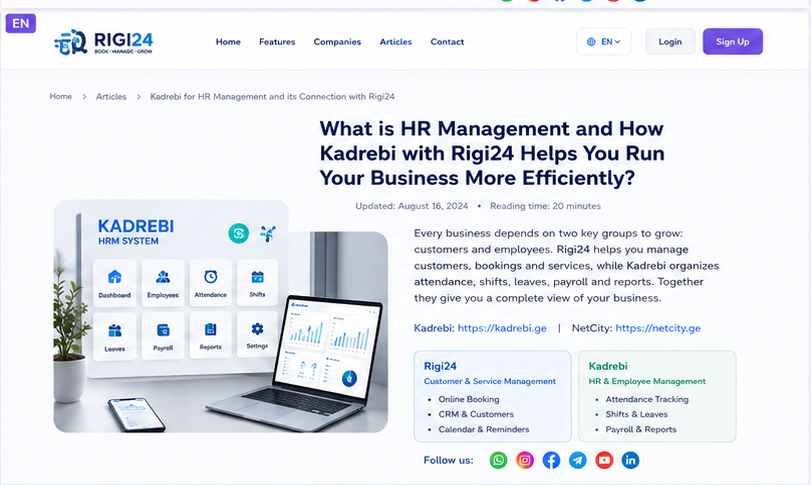
At first glance, a completely logical question may arise:
If Kadrebi is a complete human resources system and Rigi24 also has an HR module, why does NetCity offer two products in the same field?
Are these two products competitors?
Is Rigi24 going to replace Kadrebi?
Has Kadrebi become outdated?
The short answer to all three questions is “no.”
Kadrebi and Rigi24 HR come from the same team and the same company, but they were designed for two different paths.
One is a specialized, standalone human resources product.
The other is part of a modular ecosystem for managing different areas of a business.
That is exactly where the main difference lies.
First, one important point: Kadrebi is not just an attendance device
Some customers, when they hear the name Kadrebi, assume they are dealing with a simple attendance system.
But attendance is only one part of it.
Kadrebi was designed for workforce management and can cover different parts of the employee lifecycle:
- Employee files
- Employment information
- Departments
- Positions
- Contracts
- Shifts
- Work schedules
- Attendance
- Lateness
- Early departure
- Absence
- Overtime
- Leave
- Payroll
- Reports
- Multi-branch management
- Manager access
- Employee panel and app
- Connection to attendance devices
- Data analysis
- And intelligent capabilities
So we are not going to reduce Kadrebi’s value in order to introduce Rigi24.
Kadrebi remains a serious, independent product.
So why was Rigi24 HR created?
The answer goes back to a simple principle in the software world:
Software cannot remain unchanged forever.
Companies’ needs change.
The way users work changes.
Technology changes.
Security changes.
Artificial intelligence enters everyday processes.
Software products that have been developed for years usually reach a point where they face an important decision:
Should every new capability be added to the previous structure?
Or, while preserving the successful existing product, should a new generation of software architecture be created?
NetCity chose the second path.
We did not decide to turn Kadrebi, through a series of heavy changes, add-ons, and repeated modifications, into something it was not originally architected to be.
Instead, Kadrebi continues to develop as a specialized HR product, while alongside it, the new-generation HR of Rigi24 has been built on a modular and integrated architecture.
Does this mean Kadrebi is old?
No.
This is one of the most important misunderstandings that should be cleared up from the start.
In the software world, having a newer product does not mean that another product has become ineffective.
A simple example:
Many companies may have a highly specialized accounting system while their ERP also has its own finance module.
The existence of an ERP does not mean the specialized accounting software has become worthless.
The point is that each product is built for a particular usage model.
Kadrebi is a specialized HR product.
Rigi24 is a modular business-management ecosystem in which HR is one of the modules.
The main difference: a specialized product versus a modular ecosystem
This may be the most important difference between the two systems.
Kadrebi
Kadrebi was built from the beginning with a focus on employees.
The entire product philosophy revolves around human resources:
Who was hired?
Which department are they in?
Which shift do they have?
When did they arrive?
How much did they work?
How much lateness did they have?
What leave did they take?
How much overtime did they have?
How is their salary calculated?
Which report should be prepared for management?
In other words, a company enters Kadrebi because it specifically wants an HR system.
Rigi24
In Rigi24, the story is different.
A company may initially use only CRM.
Then it may activate the appointment system.
Then add internet calling.
Then activate the online store.
Then add the invoicing module.
Then it may need HR.
And in the future, it may use AI to connect these areas.
All of these modules are organized around one shared business identity.
As a result, HR in Rigi24 is not a separate island.
It is part of a larger ecosystem.
A real-world example
Suppose a medical organization has 40 employees.
If its main need is only employee management, shifts, attendance, leave, payroll, and HR reports, Kadrebi can be a very suitable choice.
But now suppose the same organization also has other needs:
- Patient management
- Appointment scheduling
- CRM
- Internet calling
- Customer follow-up
- Messaging
- Invoicing
- Service sales
- HR
- Management reporting
- And artificial intelligence
In this situation, Rigi24 gains a different advantage.
Instead of several independent systems, the company can activate the modules it needs in one shared environment.
Rigi24 is not intended to force every module on the customer
Being modular means exactly that the customer activates only what they need.
One company may want only HR.
Another may want HR and CRM.
A third company may activate HR, CRM, and PBX.
And a fourth may only use appointment scheduling and not need HR at all.
So the goal of Rigi24 is not to create a huge and cluttered software package.
The goal is to create a common core to which specialized capabilities are added according to need.
The role of artificial intelligence: one of the important differences of the new generation
One of the important areas in the development of Rigi24 is artificial intelligence.
But by AI, we do not mean only a chatbot that answers general questions.
The goal is for a manager to be able to work with the company’s real data.
For example, they could ask:
“Who arrived late today?”
Or:
“Which employees had the most underwork this month?”
Or:
“Show me the unapproved leave requests.”
Or:
“Which department is Giorgi in?”
Or even, in supported operations, say:
“Move Giorgi to the Sales department.”
In this model, artificial intelligence understands the request, but the operation must still be carried out based on:
- The company’s real data
- The user’s access level
- System rules
- Manager approval
- And audit history
So AI in Rigi24 is not intended to replace the system.
AI is the intelligence layer that works on top of the real system.
Does Kadrebi not have artificial intelligence?
Rigi24’s stronger focus on AI architecture does not mean Kadrebi is without intelligent capabilities.
Kadrebi can also use data analysis and an intelligent assistant.
The main difference is the architectural vision.
In Kadrebi, artificial intelligence serves HR processes.
In Rigi24, AI may in the future communicate not only with HR but also with other business modules.
For example, in an integrated environment, a manager may be able to ask about employees as well as customers, appointments, calls, or other authorized business data.
One of Kadrebi’s biggest advantages: compatibility with the customer’s existing infrastructure
In the real market, customers do not always start from zero.
Many companies have had attendance devices for years.
Some devices are expensive.
Some are inexpensive.
Some are made in China.
Some work with cards.
Some have PINs.
Some have biometric capabilities.
But the most important point is:
Customers usually do not want to throw away equipment they purchased and that still works.
This is completely logical.
One of Kadrebi’s advantages is that, in many projects, it can work with a customer’s existing devices or an integration solution can be defined for them.
This is especially important for companies that:
- Have several older devices
- Have multiple branches
- Have already invested in previous equipment
- Do not want to replace their hardware
- But want to use a more professional HR system
For such a customer, Kadrebi can be a much more suitable migration path.
Why does support for low-cost devices matter?
In the attendance market, not every company is willing to buy new and expensive hardware for every branch.
In many organizations, economical devices continue to work for years.
Usually, the problem is not the device itself.
The problem is the limited software that comes with it.
The device may provide only a simple entry/exit output.
But the manager needs to:
- See lateness
- Apply shifts
- Manage leave
- Approve overtime
- Get monthly reports
- Maintain employee information
- And calculate payroll based on real data
In such a scenario, keeping the device and upgrading the software layer may be far more logical than replacing the entire infrastructure.
This is one of the markets in which Kadrebi still has a serious advantage.
The employee application in Kadrebi
Kadrebi is not designed only for managers.
Employees can also use their own dedicated environment to view personal information, work schedules, attendance history, submit leave requests, and access other permitted features.
This is very important for a company that wants a standalone HR solution.
In other words, even if a company does not need any of the Rigi24 modules, it can still have a complete HR experience in Kadrebi.
What advantage does Rigi24 have compared with this model?
The advantage of Rigi24 becomes greater when HR is not the company’s only issue.
Suppose a company activates HR today.
Six months later, it wants CRM.
Then it wants WebRTC.
Then it needs an appointment system.
Then a loyalty club is added.
In the Rigi24 architecture, the goal is for these services to grow on a shared core instead of creating several accounts, several databases, several user systems, and several independent management environments.
This is where the advantage of modularity becomes clear.
The difference in “business identity”
In Kadrebi, the main identity of the system is the organization and its employees.
In Rigi24, the Business identity is broader.
Under the same identity, a company can gradually expand:
- Users
- Branches
- Customers
- Employees
- Services
- Modules
- Access permissions
- And intelligent tools
This difference becomes very important for growing companies.
If we already have Kadrebi, why not add every new feature there?
Technically, almost any feature can be added to an older software system.
But the main question is not “can it be done or not?”
The question is:
Is that the best engineering decision?
Every software product is built according to the architecture, database, access logic, and requirements of its time.
If after several years we try to add every new technology to the same structure through repeated modifications, the system may eventually become more complex, more expensive, and harder to maintain.
That is why NetCity decided that instead of turning Kadrebi into a collection of successive patches, it would develop the new generation in the Rigi24 architecture at the same time.
This decision does not mean abandoning Kadrebi.
On the contrary, it allows each product to preserve its own logical path.
For which customers is Kadrebi a more suitable choice?
Kadrebi is usually a very good choice for a company that:
- Wants a specialized HR system
- Has its main focus on employees
- Already has attendance devices
- Does not want to replace its current devices
- Uses economical or older devices
- Wants to connect its current hardware to a stronger HR system
- Needs a dedicated employee app
- Has multiple branches
- Has complex shifts
- Considers attendance a major part of operations
- Has serious payroll, leave, and HR reporting needs
- And does not necessarily need other business-management modules
For which customers is Rigi24 HR a more suitable choice?
Rigi24 HR is usually more suitable for a company that:
- Wants to use a newer architecture
- Places particular importance on AI
- Wants HR alongside other business tools
- May later activate CRM
- May need appointment scheduling
- May want a calling system
- May need a store or invoicing
- Wants to manage several modules in one environment
- Wants users and access permissions to have a shared structure across modules
- Or is building a long-term digital infrastructure for the entire company
Can a customer use Kadrebi and Rigi24 at the same time?
Yes.
This is a very important point.
Using Kadrebi does not mean the company cannot use Rigi24.
For example, a company may:
Keep Kadrebi for HR and attendance,
But use Rigi24 for CRM, appointment scheduling, WebRTC, the online store, or other modules.
The two products belong to the same ecosystem, and our philosophy is not to create internal competition between them.
The goal is that the customer should not have to abandon something that already works well for them.
Do all Kadrebi customers need to migrate to Rigi24?
No.
There is no technical or commercial reason why a satisfied customer should be forced to migrate just because a newer product exists.
If Kadrebi covers the organization’s needs well, the existing equipment works, and the company’s processes are stable, continuing to use Kadrebi is completely logical.
Migration makes sense when the company genuinely needs the advantages of the new architecture.
For example:
- Integration of multiple modules
- Broader automation
- Deeper use of AI
- Or a change in the company’s operating model
If we are starting from zero today, which one should we choose?
There is no single answer for everyone.
Scenario one
An 80-person factory already has several attendance devices and only wants to modernize its HR, shifts, leave, payroll, and reports.
Kadrebi is probably a very suitable option.
Scenario two
A 30-person clinic wants to gradually build HR, CRM, appointment scheduling, calling, and AI in one environment.
Rigi24 is probably the more suitable path.
Scenario three
A company uses Kadrebi and is completely satisfied, but now wants CRM and a calling system.
There is no need to remove Kadrebi.
It can keep Kadrebi and add the Rigi24 modules it needs.
Quick comparison table
| Topic | Kadrebi | Rigi24 HR |
|---|---|---|
| Product type | Specialized HR system | HR module in the Rigi24 ecosystem |
| Main focus | Employees and HR processes | HR alongside other business processes |
| Attendance | Yes | Yes |
| Shifts and work schedules | Yes | Yes |
| Leave | Yes | Yes |
| Overtime | Yes | Yes |
| Payroll | Yes | Yes |
| HR reports | Yes | Yes |
| Multi-branch | Yes | Yes |
| Employee access | Dedicated app and environment | Personal account and Rigi24 channels |
| Device integration | One of the main strengths | Supported in the new Rigi24 architecture |
| Keeping existing devices | Very suitable for compatible projects | Depends on the integration scenario |
| Older economical devices | Can be an important advantage | Reviewed case by case |
| Artificial intelligence | In the HR domain | AI layer in the modular ecosystem |
| CRM | Not a core Kadrebi product | Separate module that can be activated |
| Appointment scheduling | Not available | Separate module |
| Internet calling | Not available | Separate module |
| Online store | Not available | Separate module |
| Multi-product modular architecture | Focused on HR | One of the main advantages |
| Best suited for | Specialized HR and existing infrastructure | Multi-module digital transformation |
So which one is better?
The right question is not:
Is Kadrebi better, or Rigi24 HR?
The right question is:
Which architecture is more suitable for your company?
If you need a specialized, strong, standalone HR system and want to keep your existing equipment, Kadrebi can be a very good choice.
If HR is only one of several digital areas of your company and you want to gradually add CRM, communications, appointment scheduling, sales, AI, and other modules within a shared ecosystem, Rigi24 offers a different path.
NetCity’s philosophy: the customer should not become a victim of the product
We believe a customer should not be forced, merely because of a company’s sales policy, to:
Throw away equipment that still works,
Remove their current system,
Or buy modules they do not need.
Technology should adapt itself to the real needs of the business.
The business should not be forced to adapt itself to the limitations of the software.
That is why Kadrebi and Rigi24 exist side by side.
The future of these two products
Our goal is not to eliminate one in favor of the other.
Kadrebi remains a specialized human resources system.
Rigi24 continues to develop as a modular ecosystem.
Where it is logical and secure, greater communication and integration can also be created among NetCity services.
This means a customer does not have to make a decision today that puts them in a software dead end tomorrow.
Conclusion
Kadrebi and Rigi24 HR are not two competitors.
They are two different answers to two different types of need.
Kadrebi is built for an organization that wants to focus on human resources and have a specialized, standalone product.
Rigi24 HR is built for an organization that wants HR to be part of a larger, modular ecosystem based on a new generation of automation and artificial intelligence.
Kadrebi has not lost its value.
Rigi24 is also not simply a new version of Kadrebi.
One offers deep specialization in one field.
The other offers an integrated architecture for multi-module growth.
And the best choice is the product that matches the infrastructure, growth plan, and real needs of that particular company.
If you are still unsure which path is more suitable for your organization, you only need to identify three things:
The number of employees, your current equipment, and the modules you need today or may need in the future.
Based on these three factors, it is possible to determine whether Kadrebi, Rigi24 HR, or a combination of both is more logical for your company.
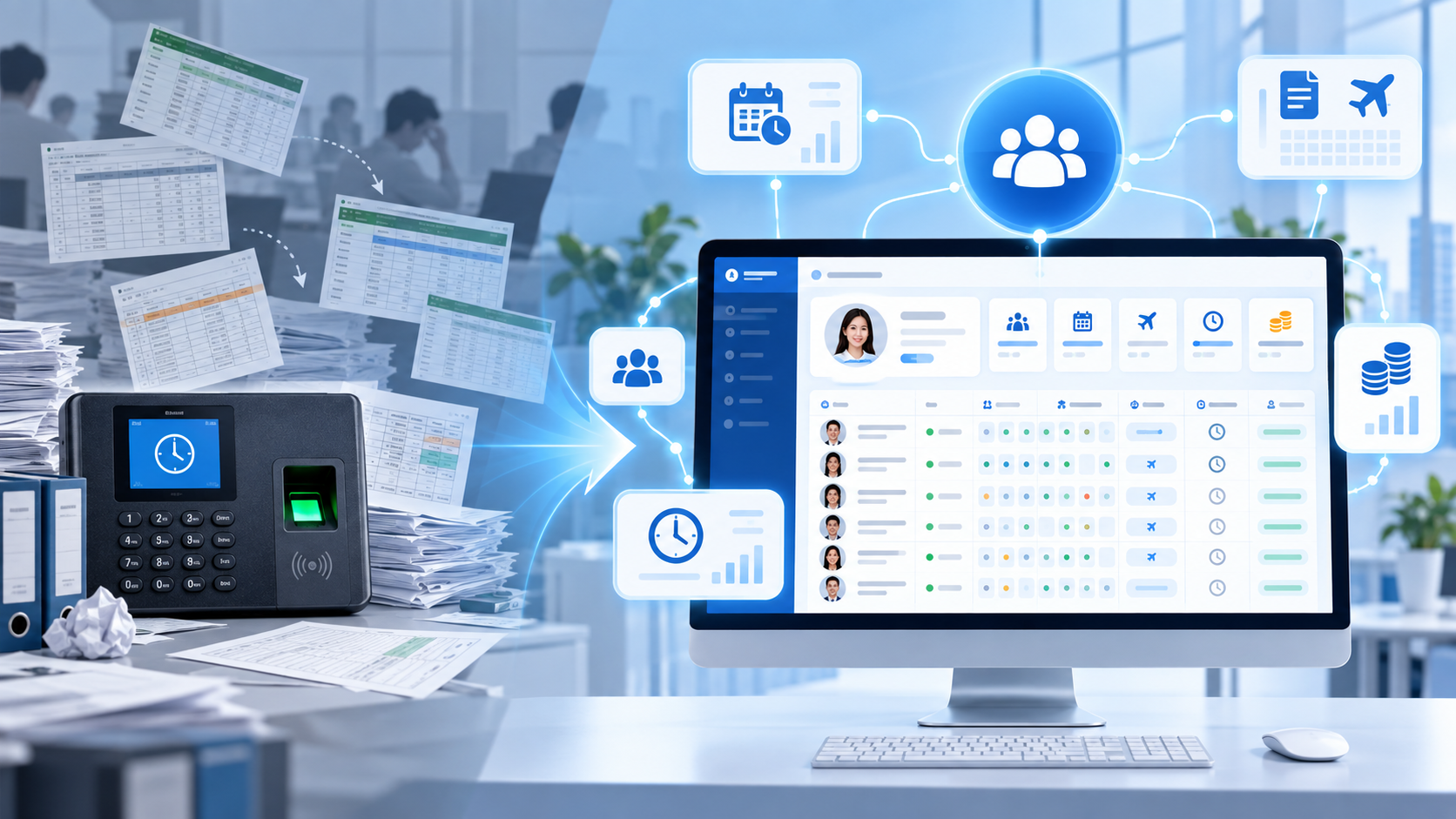 RIGI24 HR · SALES GUIDEBefore You Buy an Attendance Device: Why Your Company Needs Real HR Software
 RIGI24 HR · KADREBIKadrebi or Rigi24 HR? Why does NetCity offer two HR solutions, and which one is more suitable for your company?
 RIGI24 HR · LEAVELeave rules in Georgia in 2026: a practical guide for employers and employees
 RIGI24 HR · LABOUR LAWGeorgia labour law and work permits for foreigners in 2026: updated guide